
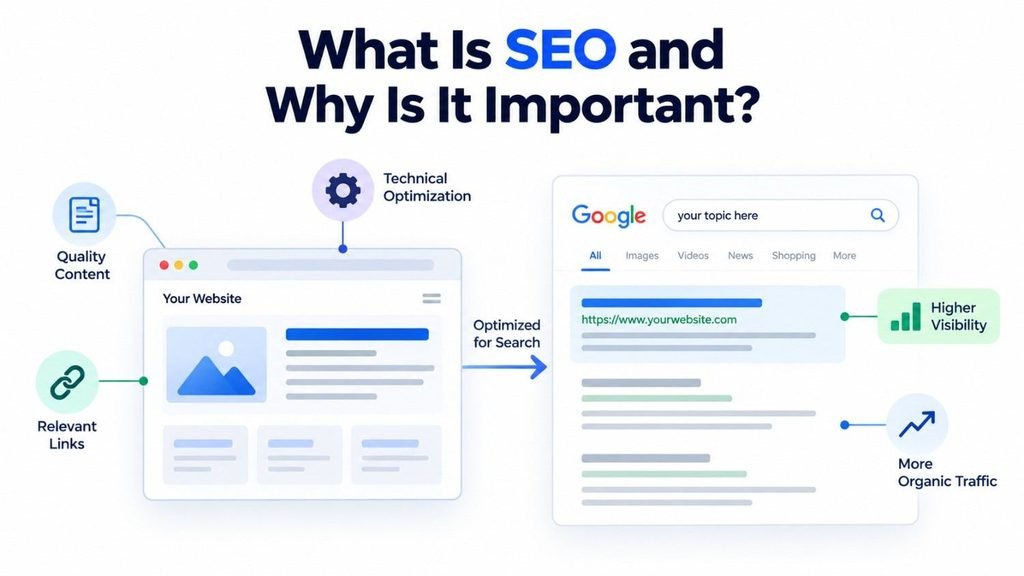
If you have a website, getting people to find it is just as important as having good content or a good product. Search engine optimization, or SEO, helps your pages become easier for search engines to understand and easier for people to discover when they search for something related to your business, service, or topic.
In simple words, SEO is the process of improving a website so it has a better chance of appearing in relevant organic search results. It is not about paying Google to rank a page.
Instead, it involves improving things such as content, page structure, technical setup, and links so search engines can better understand what your website offers. This guide explains what SEO means, how it works at a basic level, why it is important, and what a beginner should focus on first.
What Is SEO?
SEO stands for Search Engine Optimization. It is the practice of improving a website and its pages to increase their visibility in organic search results.
Suppose you run a website that sells running shoes. Someone searches Google for “best running shoes for beginners.” If you have a useful page that answers that question clearly and your website is technically accessible to search engines, SEO can help that page become eligible to appear for the search.
The goal is not simply to get more visitors. Good SEO aims to attract relevant visitors who are actually looking for the information, product, or service your website provides.
Google describes SEO as helping search engines understand your content and helping users find your site through search. Its SEO Starter Guide also emphasizes useful, well-organized, people-first content rather than secret techniques for automatically reaching the top of Search.
What Is SEO in Simple Words?
If you’re completely new to SEO, think of it this way:
SEO helps the right people find the right page on your website through search engines.
Imagine you open a bakery but do not put up a sign outside. You may have excellent products, but people walking nearby may not know the bakery exists.
A website can have a similar problem. You can publish a great article or offer an excellent service, but if search engines cannot properly understand the page or users cannot find it through relevant searches, the page may receive very little organic traffic.
SEO helps solve that discoverability problem.
It can involve choosing topics people actually search for, creating useful content, improving page titles and headings, making the website easier to crawl, building relevant links, and fixing technical problems that can interfere with search visibility.
How Does SEO Work?
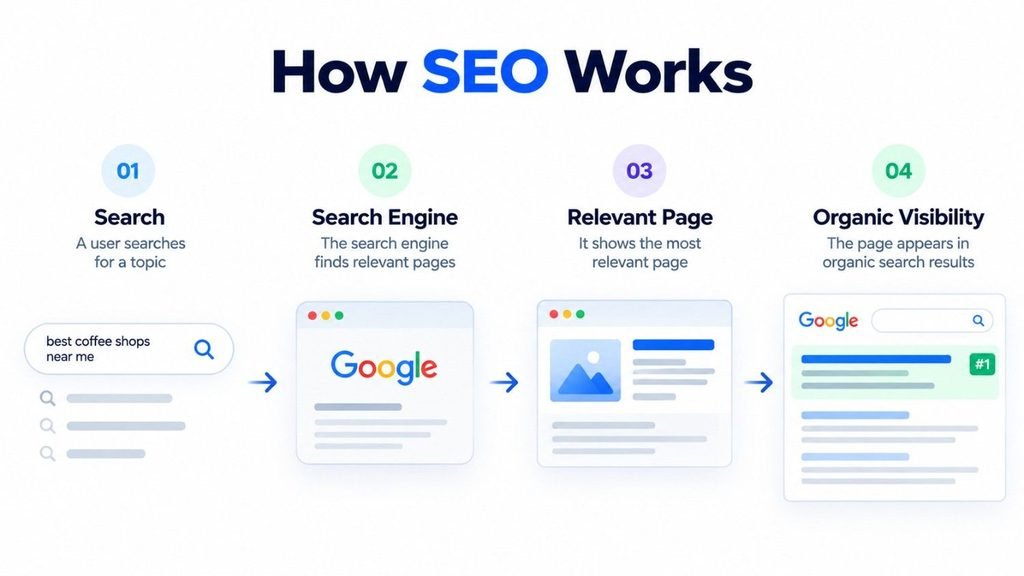
Search engines need to discover pages, understand what those pages are about, and decide which results are most relevant to a user’s search.
At a basic level, SEO works by making your website easier to discover, understand, and evaluate.
1. Search engines discover your pages
Search engines use automated crawlers to find pages across the web. Google says it primarily discovers pages through links from pages it has already crawled, although there are other ways pages can be discovered.
For example, if you publish a new article and another page on your website links to it, that link can help search engines discover the new page.
2. Search engines understand your content
Once a page is discovered, search engines need to understand what it contains.
Clear headings, descriptive page titles, useful content, logical site structure, relevant internal links, and descriptive URLs can all help communicate what a page is about.
This is one reason SEO is not simply about adding keywords to an article. Search engines have become much better at understanding language and the overall topic of a page.
3. Search engines decide which results are relevant
When someone searches for something, the search engine has to choose which pages are the best match from the pages it knows about.
Relevance is only part of the picture. Search systems use many signals to determine which results are useful for a particular query.
That means there is no single SEO trick that guarantees a first-place ranking. Even Google explicitly states that there are no secrets that automatically rank a website first.
What Is the Use of SEO?
The main use of SEO is to improve a website’s visibility in organic search and help it attract relevant visitors.
For example, consider a dentist who has a page about teeth whitening. Someone searches “teeth whitening dentist near me.” If the dentist’s website is relevant, accessible, useful, and competitive for that search, SEO can help the page appear in front of people who may actually need the service.
SEO can be useful for several reasons:
- Increase organic visibility: More relevant searches can potentially expose your website to more people.
- Attract targeted traffic: Visitors may already be looking for the information, product, or service you offer.
- Build long-term visibility: Unlike an ad that stops running when its budget ends, an organic result can continue receiving impressions and clicks while it remains useful and competitive.
- Help users find useful information: Good SEO often involves making pages clearer and easier to navigate.
- Support business goals: For commercial websites, organic search traffic can contribute to leads, sales, enquiries, or other conversions.
SEO does require ongoing work, though. It is not a way to get unlimited free traffic without investment. Creating useful content, maintaining a website, researching search demand, and improving pages all require time and effort.
Why Is SEO Important?
SEO is also important because search engines are one of the ways people discover information, businesses, products, and services. If you’re new to digital marketing, it helps to understand where SEO fits within the bigger picture. Our guide to what digital marketing is and its different types explains how SEO connects with other channels such as content marketing, social media marketing, email marketing, and paid advertising.
Imagine someone needs a new laptop. They might search for “best laptop for students,” compare different pages, visit product websites, read reviews, and eventually make a purchase.
Now imagine you sell laptops but your website rarely appears for relevant searches. Even if your products are good, you may miss people who are actively looking for what you offer.
That is the basic business value of SEO: it can put your website in front of people at the moment they are searching for something relevant.
SEO is also important because search visibility is not limited to one type of website. A blog can use SEO to attract readers, a local business can use it to reach nearby customers, an ecommerce store can use it to make product pages discoverable, and a software company can use it to attract people researching solutions.
For a site like WolfieDigi, SEO is especially relevant because the purpose is to make useful digital marketing knowledge easier for people to discover through search.
What Are the Main Areas of SEO?
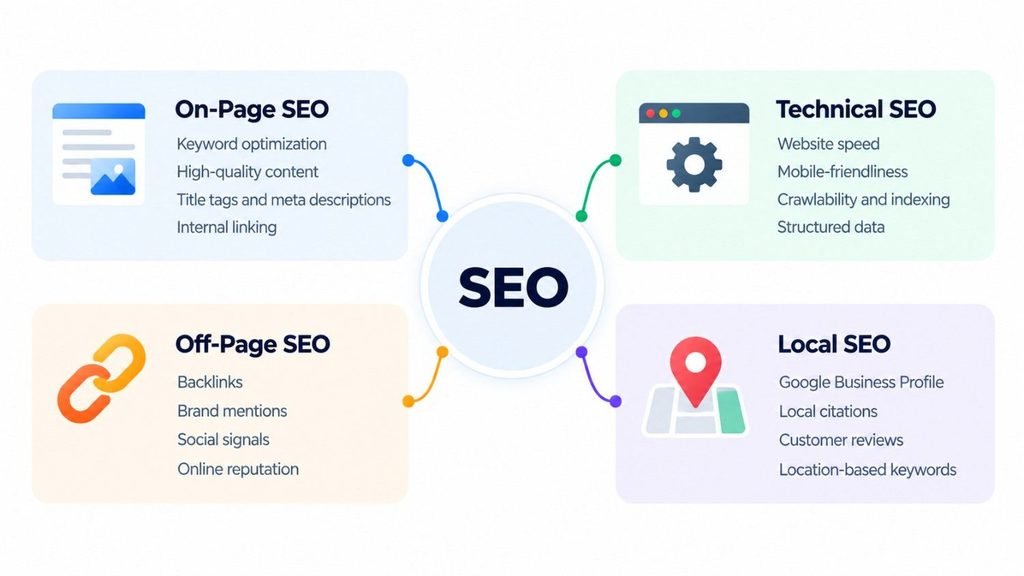
SEO is a broad field, but beginners can understand it through a few major areas.
On-Page SEO
On-page SEO focuses on the content and elements on a webpage.
This can include:
- Page titles
- Headings
- Content quality
- Search intent
- Keywords and related topics
- Internal links
- Image descriptions
- URLs
The purpose is to make the page useful for visitors and clear to search engines.
For example, an article targeting a beginner query should actually explain the subject in language a beginner can understand instead of simply repeating the target keyword.
Technical SEO
Technical SEO focuses on the parts of a website that affect how search engines access, crawl, understand, and index its pages.
Examples include:
- Crawlability
- Indexing
- Site structure
- Mobile usability
- Page performance
- HTTPS
- Canonical URLs
- XML sitemaps
You do not need to become a developer to start learning SEO, but understanding these fundamentals becomes increasingly important as a website grows.
Off-Page SEO
Off-page SEO refers to activities and signals that happen outside your own website.
One major area is earning links from other relevant websites. These links can help search engines discover pages and can also act as references connecting one website to another.
However, off-page SEO is not simply about creating as many backlinks as possible. The relevance and quality of links matter more than treating link building as a numbers game.
Local SEO
Local SEO focuses on improving visibility for searches connected to a specific location.
For example, someone searching for “dentist in Pune” has a different need from someone searching for “what is SEO.”
Local SEO can involve a business’s website, Google Business Profile, local information, reviews, and other signals that help people find a business in a particular area.
How Has AI Changed SEO?
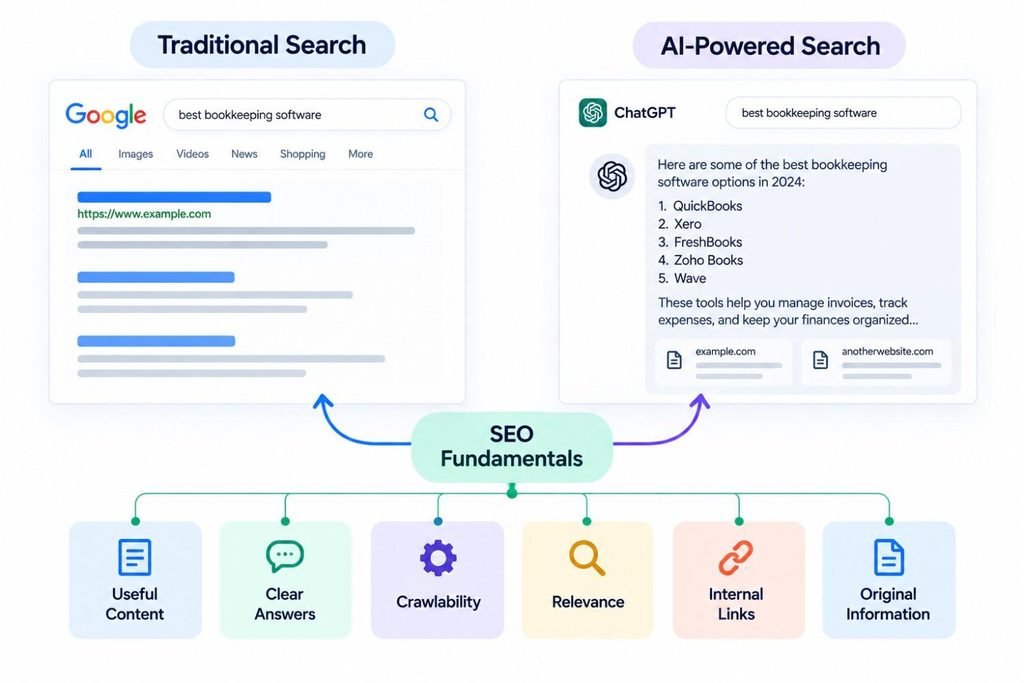
AI has changed how people search for information. Instead of always scanning a traditional list of blue links, users may now get an AI-generated response that combines information from multiple sources and can lead them to relevant webpages.
This does not mean that traditional SEO has become irrelevant. Google’s AI Overviews and AI Mode still rely on its underlying Search systems, so the fundamentals remain important: your pages need to be accessible to search engines, understandable, useful, and relevant to the questions people ask.
What Is AI SEO?
You may hear terms such as AI SEO, AEO (Answer Engine Optimization), or GEO (Generative Engine Optimization) when people discuss optimization for AI-powered search.
These terms generally refer to improving content so it can be understood, surfaced, or referenced in AI-generated search experiences. However, they should not be treated as a completely separate replacement for SEO.
The fundamentals still matter. Clear answers, useful information, logical structure, relevant context, strong internal linking, and original insights can help both traditional search systems and newer AI-powered search experiences understand your content.
What Should You Focus on for AI-Powered Search?
You do not need a special trick to make your content appear in AI-generated results. A better approach is to create content that genuinely answers the user’s question and provides information that is useful beyond a basic restatement of what other pages already say.
For example, if you are explaining what SEO is, simply defining SEO may not be enough. A stronger page can explain the concept in simple language, show a familiar example, explain how SEO works, distinguish it from paid search, and address common beginner questions.
This kind of comprehensive, well-structured content can serve users whether they discover it through a traditional search result or an AI-powered search experience.
Google’s current guidance on AI features in Search also emphasizes that the same fundamental SEO practices continue to apply. There is no separate set of requirements that guarantees inclusion in AI Overviews or AI Mode.
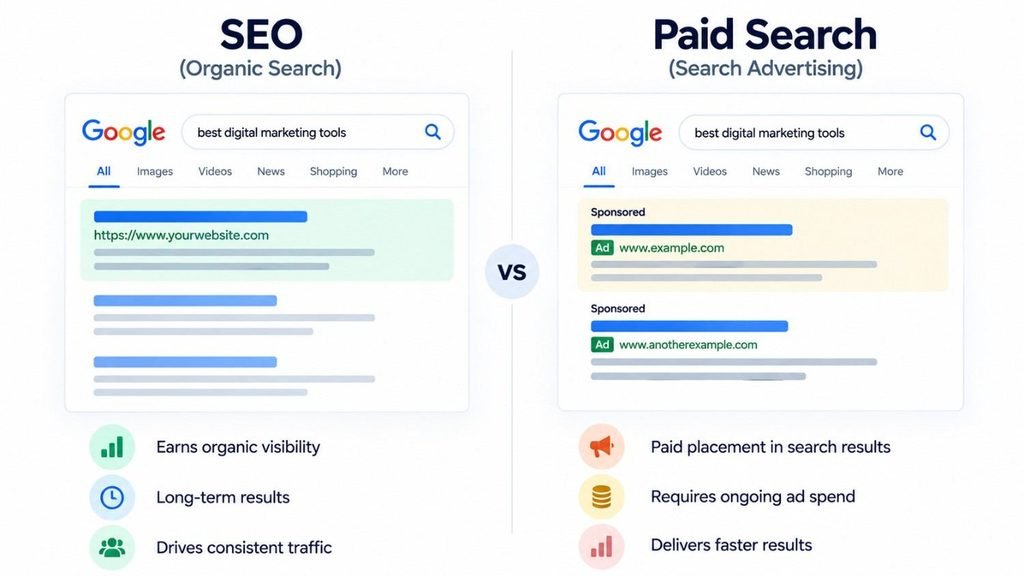
SEO vs Paid Search: What Is the Difference?
SEO and paid search can both help a website appear in search results, but they work differently.
With paid search, a business pays for advertising placements through platforms such as Google Ads.
With SEO, the goal is to earn visibility in the organic results by improving the website and its content.
For example, a company selling running shoes could run a Google Search ad for “buy running shoes online.” At the same time, it could publish useful content and optimize product pages to compete for relevant organic searches.
The two approaches can work together, but SEO should not be treated as simply a free version of advertising. Organic visibility depends on relevance, quality, competition, technical accessibility, and many other factors.
Is SEO Only About Google?
No. SEO is a general term for optimizing content and websites for search engines.
Google is the dominant search engine for many websites, so much of the SEO advice beginners encounter is focused on Google Search. But the underlying idea can apply to other search systems as well.
The exact systems and ranking processes can differ, so SEO should not be reduced to a list of instructions designed for one platform.
The broader goal is to make your content easy for the relevant search system to discover, understand, and connect with the right users.
Is SEO Important for Beginners?
Yes, but beginners do not need to learn everything at once.
You do not need to start with advanced technical SEO, complicated link-building campaigns, or dozens of expensive tools.
A better starting point is to understand the fundamentals:
- Learn how search engines discover and organize pages.
- Understand what people are searching for.
- Learn how search intent affects the type of content you create.
- Create useful content that genuinely answers the query.
- Learn basic on-page SEO.
- Make sure important pages can be crawled and indexed.
- Understand internal links and why they matter.
- Track how your pages perform and improve them over time.
Google’s own beginner documentation follows a similar principle: start with useful, well-organized content and basic search accessibility rather than chasing complicated SEO theories.
Common Misunderstandings About SEO
SEO does not guarantee the first position
No legitimate SEO method can guarantee that a page will rank first for a competitive search. Search engines evaluate many signals, and rankings can change as competition, content, and search systems change.
SEO is not keyword stuffing
Repeating a keyword dozens of times does not automatically make a page more relevant. Google specifically warns against keyword stuffing, and its current guidance recommends writing naturally for users.
SEO is not only backlinks
Links can matter, but SEO also includes content, technical accessibility, site structure, search intent, user experience, and many other considerations.
SEO is not a one-time task
A website can need ongoing improvements as new content is published, competitors change, search behavior changes, and existing pages become outdated.
How Can You Start Learning SEO?
If you’re starting from zero, avoid trying to memorize hundreds of SEO terms.
Start with one website and learn by doing.
Choose a topic people actually search for, research the search intent, create a useful page, optimize its basic on-page elements, make sure search engines can access it, and then monitor what happens.
From there, you can gradually learn keyword research, technical SEO, content optimization, internal linking, off-page SEO, local SEO, analytics, and other areas.
The important thing is to understand why you’re making an SEO change rather than blindly following a checklist.
Final Thoughts
SEO is the process of improving a website so search engines can better understand its pages and people can more easily discover relevant content through organic search.
For beginners, the most useful way to think about SEO is not as a collection of tricks. It is a combination of understanding what people search for, creating genuinely useful pages, making those pages accessible to search engines, and improving the website over time.
If you are new to digital marketing, SEO is also one part of the larger field of digital marketing, alongside areas such as content marketing, social media marketing, email marketing, and paid advertising.
The best place to start is with the fundamentals. Once you understand how search works and why people search for something, the individual SEO techniques become much easier to understand.