
Most people interact with digital marketing every day without thinking about it.
You might search Google for a nearby restaurant, see a product on Instagram, receive a promotional email, or watch a YouTube video before buying something. All of these can be part of digital marketing.
So, what exactly is digital marketing?
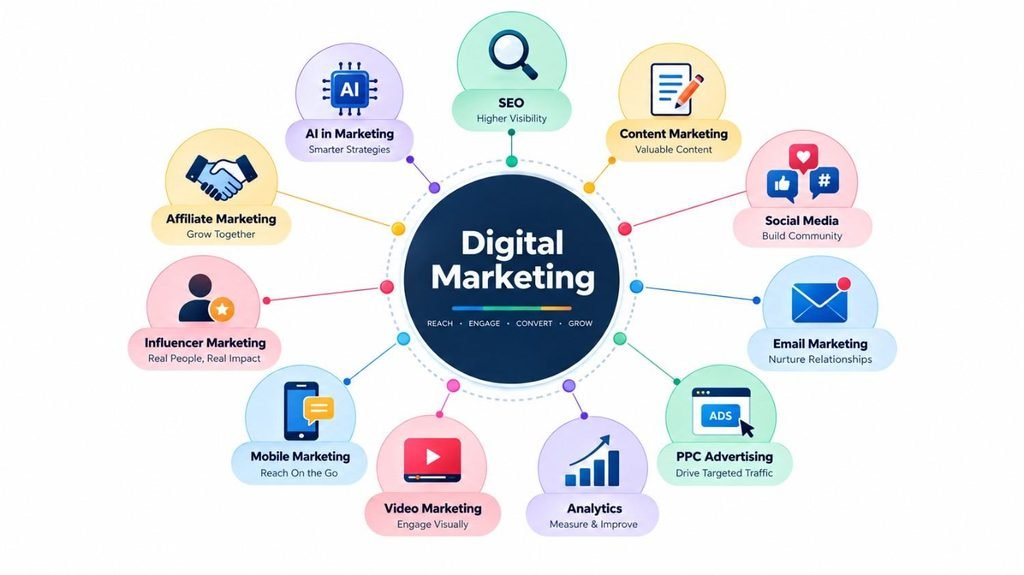
Digital marketing is the use of digital channels such as search engines, websites, social media, email, online advertising, and mobile platforms to promote products, services, or brands and connect with potential customers.
Unlike traditional marketing, digital marketing gives businesses more ways to reach specific audiences and measure what happens after people interact with their marketing.
What Is Digital Marketing?
Digital marketing is marketing carried out through digital channels.
A business can use its website to explain its products, search engines to attract people who are already looking for something, social media to build awareness, email to stay connected with existing customers, or paid advertising to reach a specific audience.
The important part is that these channels work together. A person might discover a company through Google, visit its website, follow it on Instagram, and eventually become a customer after receiving an email.
Digital marketing is therefore not just about posting on social media or running advertisements. It is a broader process of attracting people, communicating with them, and helping them move toward an action that matters to the business.
What Is Digital Marketing With an Example?
Consider a local dental clinic that wants to attract more patients.
The clinic could create pages targeting searches such as “dentist near me” and improve its Google Business Profile so people can find it in local search. It might also share useful dental advice on Instagram and run Google Ads for people actively searching for dental services.
Someone could first discover the clinic through Google, visit its website, read about a treatment, and then book an appointment.
That entire journey can involve several digital marketing channels working together.
The same idea applies to an online store, software company, education business, restaurant, or almost any other type of business. The channels may change, but the basic purpose remains the same: reach the right people and move them toward a useful business outcome.
How Does Digital Marketing Work?
Digital marketing usually starts with a business goal.
Maybe the business wants more people to know about its brand. Maybe it needs more website visitors, leads, app downloads, or sales. The goal affects almost every decision that comes after it.
The business then needs to understand its audience. Who are they? What are they looking for? What problems are they trying to solve? Where do they spend time online?
Once that is clear, the business can choose the channels that make sense.
A simplified process looks like this:
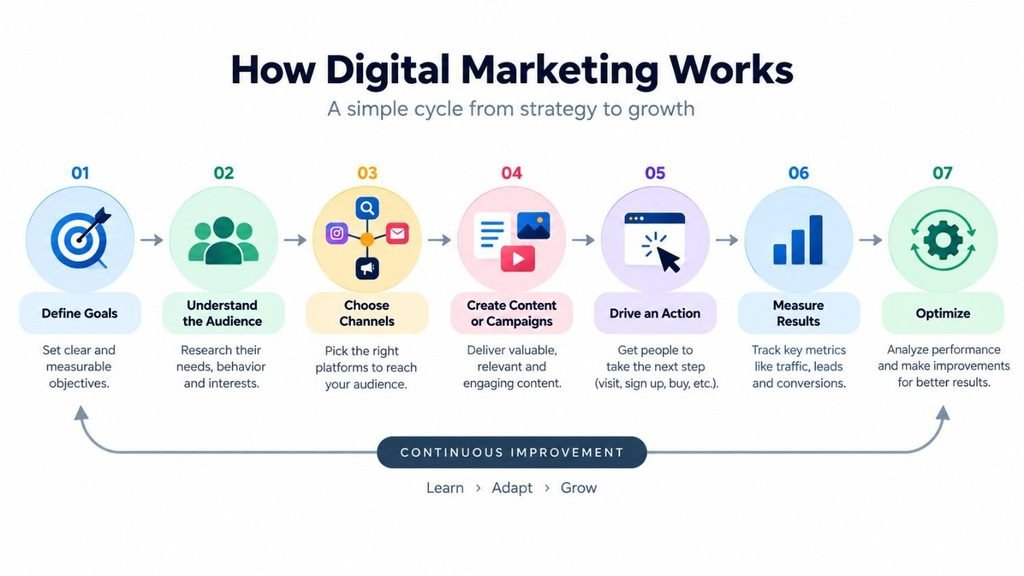
1. Define the goal
Start with a specific outcome. The goal could be increasing brand awareness, generating leads, getting more sales, or bringing more people to a website.
2. Understand the audience
Find out who you are trying to reach and what matters to them. Their needs and online behavior should influence your marketing approach.
3. Choose the right channels
There is no need to use every digital channel. A business should focus on the places where its audience is most likely to be found.
4. Create useful content or offers
The message needs to give people a reason to pay attention. Depending on the channel, that could be an article, video, advertisement, email, product page, guide, or special offer.
5. Measure what happens
Digital marketing produces data. Businesses can look at things such as website traffic, leads, conversions, sales, engagement, and advertising performance.
6. Improve the approach
The first version of a campaign is rarely perfect. Marketers use the results to understand what worked, what didn’t, and what should change next.
This is one of the biggest advantages of digital marketing. Marketing decisions can be based on actual results rather than relying entirely on assumptions.
10 Types of Digital Marketing
Digital marketing includes several different disciplines. Some focus on attracting people through organic channels, while others involve paid promotion or direct communication.
Here are 10 common types:
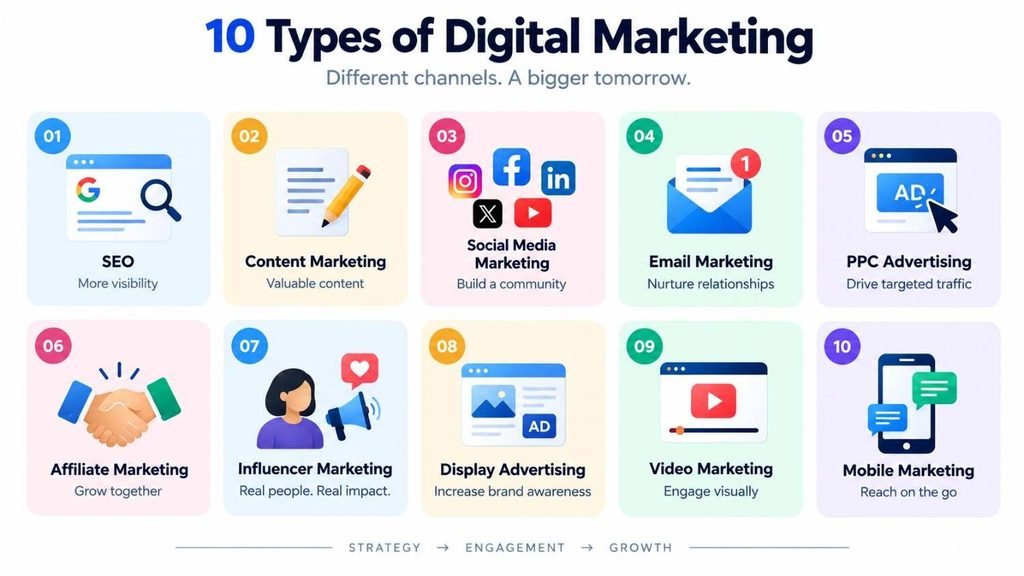
1. Search Engine Optimization (SEO)
SEO is the process of improving a website and its content so that it can appear more prominently in relevant search results.
For example, a dentist could create a useful page about dental implants that answers the questions potential patients commonly search for.
SEO can bring visitors to a website without paying for every individual click.
2. Content Marketing
Content marketing focuses on creating and distributing useful content for a specific audience.
Blog posts, guides, videos, case studies, newsletters, and other resources can all be part of a content marketing strategy.
The goal isn’t simply to publish more content. Good content should help the audience solve a problem, answer a question, or make a decision.
3. Social Media Marketing
Social media marketing uses platforms such as Instagram, Facebook, LinkedIn, TikTok, and others to communicate with an audience.
Businesses can use social media to introduce their brand, share content, interact with customers, promote products, and build a community.
The right platform depends heavily on the audience and the type of business.
4. Email Marketing
Email marketing allows businesses to communicate directly with people who have chosen to receive their emails.
Companies use email for newsletters, product announcements, offers, educational content, onboarding, and customer retention.
For example, an online store might send a new customer a welcome email and later recommend products based on their interests.
5. PPC Advertising
Pay-per-click (PPC) advertising allows businesses to pay for ads that appear on platforms such as search engines and other digital properties.
With search advertising, a company might bid on keywords related to its products or services. When someone searches for those terms, an advertisement may appear alongside the organic results.
PPC can provide relatively fast visibility, but businesses need to manage their campaigns carefully because every click can have a cost.
6. Affiliate Marketing
Affiliate marketing involves working with individuals or organizations that promote a company’s products or services.
The affiliate typically receives a commission when its referral results in a specified action, such as a sale.
For example, a website that reviews software might include an affiliate link to the software provider. If a reader purchases through that link, the website may receive a commission.
7. Influencer Marketing
Influencer marketing involves collaborating with people who have an established audience on a digital platform.
A brand might work with a creator whose audience matches its target customers. The creator could demonstrate a product, review it, or introduce the brand to their followers.
The effectiveness of influencer marketing depends on factors such as audience relevance, credibility, content quality, and the type of partnership.
8. Display Advertising
Display advertising uses visual ads that appear across websites, apps, and other digital properties.
These advertisements can contain images, text, animation, or video. Businesses can use them to build awareness, promote products, or bring previous website visitors back to their site.
9. Video Marketing
Video marketing uses video content to educate, entertain, demonstrate products, or communicate a brand’s message.
YouTube is one of the most obvious examples, but businesses also use video across websites and social platforms.
A software company, for example, might create a short tutorial showing potential customers how its product works.
This can include mobile-friendly websites, SMS campaigns, app notifications, mobile advertising, and other experiences designed for smartphone users.
10. Mobile Marketing
Mobile marketing focuses on reaching people through mobile devices.
Since many people use their phones throughout the day, mobile experience is now relevant to almost every digital marketing strategy.
What Are the Main Features of Digital Marketing?
Digital marketing has several characteristics that distinguish it from many traditional marketing methods.
Targeted reach
Businesses can target specific audiences based on factors such as interests, location, demographics, behavior, or previous interactions, depending on the platform.
Measurable results
Digital channels generate data that can help marketers understand what people did after seeing or interacting with a campaign.
Two-way communication
Many digital channels allow businesses and customers to interact directly. A customer can comment on a social post, reply to an email, leave a review, or contact a business through its website.
Multiple channels
A digital marketing strategy can combine search, content, social media, email, advertising, video, and other channels instead of depending on one source of traffic.
Personalization
Digital platforms can make it possible to deliver different messages or experiences to different groups of people based on available data and their interactions with a business.
Flexibility
Campaigns can often be changed after they launch. If an advertisement performs poorly, for example, marketers can adjust the audience, creative, budget, or messaging rather than simply waiting until the campaign ends.
What Is AI in Digital Marketing?
Artificial intelligence is becoming part of many digital marketing activities.
Marketers can use AI tools to help analyze data, generate ideas, summarize information, create drafts, identify patterns, personalize experiences, and automate certain repetitive tasks.
For example, an ecommerce company could use AI to analyze customer behavior and identify products that may be relevant to different groups of customers. A content team might use AI to organize research or generate initial ideas before creating the final content.
AI can make some marketing work faster, but it does not remove the need for human judgment.
A marketer still needs to understand the audience, check information, make strategic decisions, and decide whether the final message is actually useful. Using AI simply to produce large amounts of generic content is unlikely to create much value.
![AI supporting digital marketing functions]](https://wolfiedigi.com/wp-content/uploads/2026/09/ai-in-digital-marketing-1024x576.jpeg "What Is Digital Marketing? 10 Types, How It Works, and Key Features 4")
Why Is Digital Marketing Important?
People spend a significant amount of their time online, and businesses need ways to reach them where they already search, communicate, learn, and shop.
Digital marketing gives businesses several ways to do that.
A new company can use content and SEO to build organic visibility. A local business can focus on local search and social media. An ecommerce brand can combine paid advertising, email, content, and social media. A B2B company might rely heavily on search, educational content, LinkedIn, and email.
There is no single digital marketing strategy that works for every business.
The right approach depends on the audience, business model, goals, budget, and customer journey.
For a knowledge-focused website such as WolfieDigi, understanding these different channels is useful because they are connected. SEO, content, social media, email, paid advertising, analytics, and AI can each play a different role within a larger marketing strategy.
Final Thoughts
Digital marketing is much broader than advertising on the internet.
It includes the different ways businesses use digital channels to attract people, communicate with them, build relationships, and generate business results.
SEO, content marketing, social media, email, PPC, affiliate marketing, influencer marketing, display advertising, video marketing, and mobile marketing are some of the major areas that fall under digital marketing.
The important thing is not to use every channel simply because it exists. Start with the audience and the business goal, choose the channels that fit, create something useful, and use the results to improve the approach over time.
That is what makes digital marketing a strategy rather than just a collection of online promotional activities.