
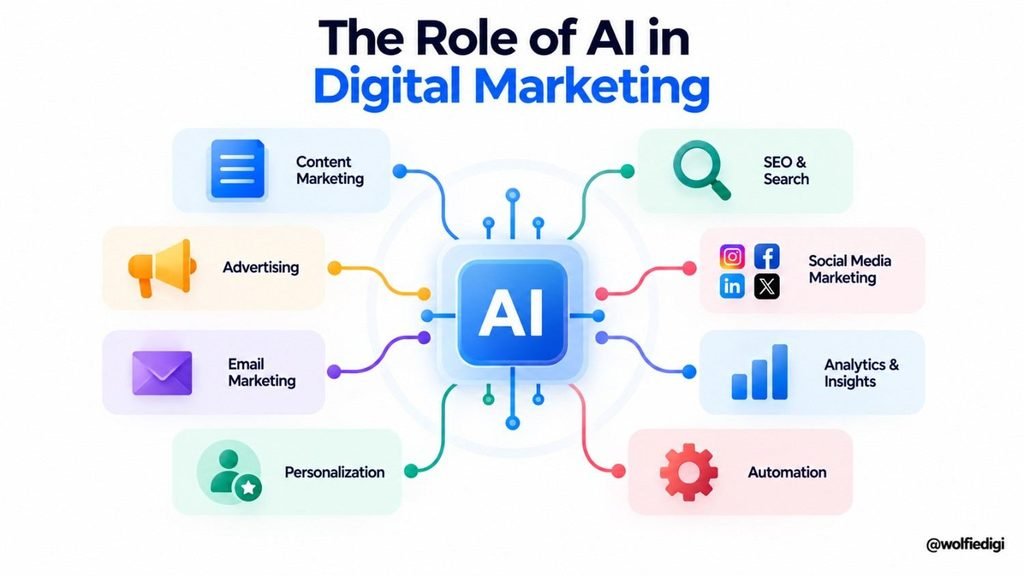
Artificial intelligence is changing how digital marketing is planned, executed, measured, and optimized. Marketers now use AI to analyze large amounts of data, personalize customer experiences, generate content, improve advertising campaigns, automate repetitive tasks, and identify patterns that would be difficult to find manually.
But AI is not a replacement for digital marketing itself. It is a set of technologies that can improve parts of the marketing process. The marketer still needs to decide what the business is trying to achieve, who it wants to reach, what it should communicate, and whether an AI-generated recommendation actually makes sense.
In 2026, this distinction is becoming more important as AI moves beyond standalone writing tools and into the marketing platforms businesses already use. Google Ads, for example, uses AI across bidding, targeting, creative optimization, and other campaign functions, while Google Analytics provides AI-generated overviews and insights about changes in marketing data.
What Is the Role of Artificial Intelligence in Digital Marketing?
The role of artificial intelligence in digital marketing is to help marketers analyze information, automate tasks, personalize experiences, generate and optimize content, and make faster marketing decisions.
Traditional marketing software generally follows predefined rules. AI systems can analyze large datasets, identify patterns, make predictions, generate content, or recommend actions based on the information available to them.
For example, an AI-powered marketing system might:
- Identify which customers are more likely to convert
- Recommend products based on customer behavior
- Generate several versions of an advertisement
- Predict which audience may respond to a campaign
- Identify unusual changes in website traffic
- Personalize email content
- Summarize marketing performance
- Help a marketer analyze customer feedback
The exact capability depends on the system. Not every tool described as “AI-powered” uses AI in the same way.
What Is AI in Digital Marketing in Simple Words?
In simple words, AI in digital marketing means using artificial intelligence to help a business understand customers, create marketing materials, automate work, and improve marketing decisions.
Imagine an online store with thousands of customers.
A human marketer could manually examine customer behavior and create different messages for different groups, but doing this for every customer would be difficult.
An AI system can process large amounts of behavioral data and help identify patterns, such as customers who frequently buy a particular product or visitors who are likely to leave without purchasing.
The marketer can then use those insights to create more relevant campaigns.
This is the basic idea behind AI-driven digital marketing: use technology to handle patterns, scale, and repetitive work while people remain responsible for strategy and judgment.
What Is the Use of AI in Digital Marketing?
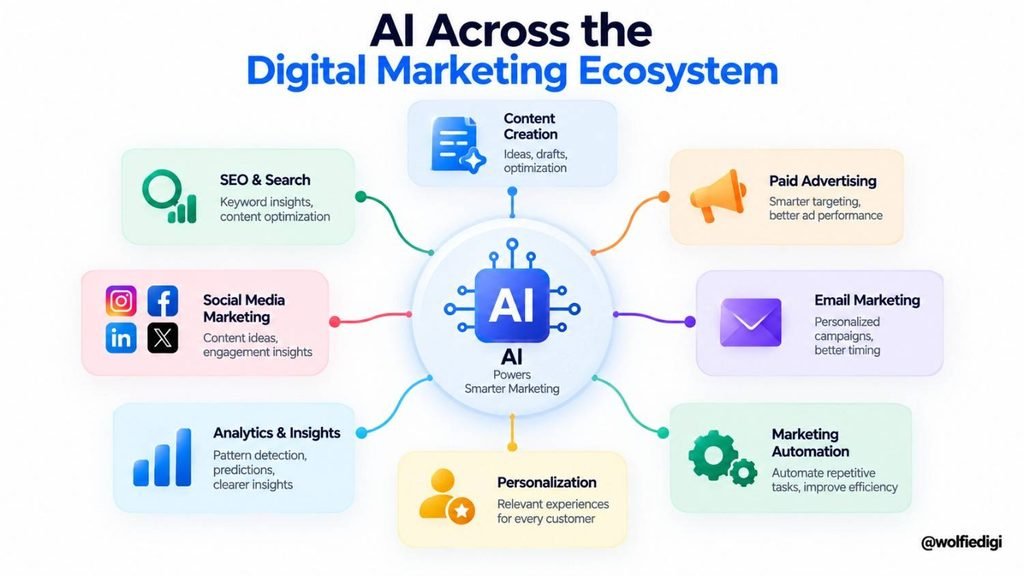
AI can be used throughout the digital marketing process rather than in just one channel.
Content Creation
Generative AI can help marketers brainstorm ideas, create outlines, draft copy, rewrite existing material, and produce variations for different channels.
For example, a marketer could use AI to create several social media caption ideas from a single campaign brief and then edit the strongest versions before publishing them.
The important point is that generating content is only one use of AI. The value comes from how the output is reviewed, improved, and connected to a real marketing objective.
SEO and Search
AI can assist with tasks such as:
- Keyword research
- Topic discovery
- Content outlining
- Search-intent analysis
- Content optimization
- Competitor analysis
- Identifying content gaps
AI is also changing the search environment itself. Search engines increasingly use AI to understand complex queries and provide synthesized answers.
For marketers, this means SEO is no longer only about matching an exact keyword. Understanding topics, entities, user intent, useful content, and how information is interpreted across search experiences is becoming increasingly important.
Paid Advertising
Advertising platforms increasingly use AI to automate parts of campaign management.
Google’s Performance Max, for example, uses Google AI for bidding, budget optimization, audience selection, creative optimization, and attribution.
Google has also introduced AI Max for Search campaigns, which uses AI-powered capabilities for search-term matching, creative customization, and landing-page expansion.
This means marketers increasingly provide goals, budgets, creative assets, audience information, and business constraints while the platform handles more of the optimization process.
Email Marketing
AI can help email marketers with:
- Subject-line ideas
- Content variations
- Audience segmentation
- Personalization
- Send-time optimization
- Product recommendations
- Campaign analysis
For example, an e-commerce company could use customer behavior to identify which products are most relevant to different subscribers and use that information to personalize email campaigns.
Social Media Marketing
AI can support social media work by helping marketers:
- Generate content ideas
- Adapt content for different platforms
- Analyze engagement
- Identify trends
- Monitor conversations
- Suggest posting opportunities
- Create creative variations
Some platforms are also using AI directly within advertising and creative workflows. Meta, for example, offers AI-enabled Advantage features for ad delivery and creative optimization.
Analytics and Data Analysis
Marketing teams generate large amounts of data from websites, advertising platforms, social media, email, and other systems.
AI can help identify patterns and summarize changes more quickly.
Google Analytics, for example, provides AI-generated overviews that summarize important changes in analytics data and can surface trends or anomalies for further investigation.
Customer Service and Conversational Marketing
AI-powered chatbots and conversational systems can answer common questions, guide visitors, qualify leads, and provide support.
This can be particularly useful when customers need immediate answers outside normal business hours.
However, automated customer interactions still need appropriate boundaries. Complex, sensitive, or unusual situations may require human involvement.
What Are Some Examples of AI in Digital Marketing?
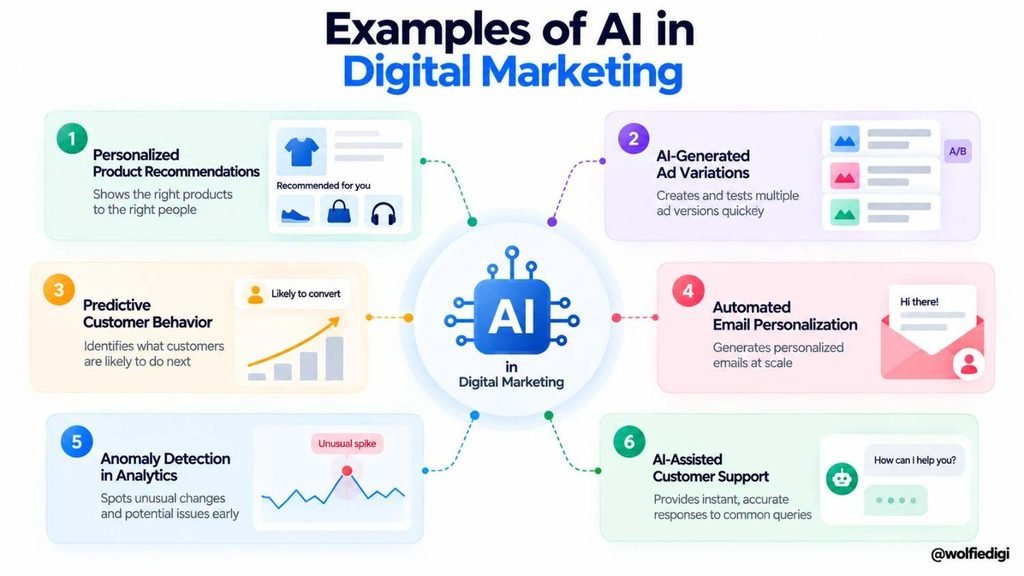
The easiest way to understand AI in marketing is through practical examples.
Example 1: Personalized Product Recommendations
An online store can analyze a customer’s previous interactions and recommend products that are more relevant to that person.
For example, someone who frequently views running shoes might receive recommendations for running accessories or related footwear.
Example 2: AI-Generated Ad Variations
A marketer can provide a campaign goal, product information, and existing brand messaging to an AI system and generate multiple ad-copy variations.
The marketer can then review the versions and test appropriate ones.
Google’s current advertising products increasingly use AI to generate or customize advertising assets based on campaign context. AI Max, for example, can generate additional headlines and descriptions based on information such as the advertiser’s domain, landing page, existing ads, and keywords.
Example 3: Predicting Customer Behavior
AI can analyze historical customer data to estimate which customers are more likely to purchase, churn, or respond to a particular offer.
A CRM system might use these predictions to help a sales or marketing team prioritize certain leads.
Example 4: Automated Email Personalization
A business can use customer behavior and preferences to create different email experiences for different audience segments.
Someone who has purchased a product might receive an onboarding sequence, while someone who has only browsed the product may receive educational information or a different offer.
Example 5: Detecting Marketing Anomalies
Suppose website conversions suddenly fall by 30%.
Instead of manually checking every report, an analytics system can flag the unusual change and help the marketer investigate possible causes.
This does not prove why the change happened. It simply helps the marketer find the issue faster.
Example 6: AI-Assisted Customer Support
An AI chatbot can answer common questions about shipping, pricing, product features, or account processes.
If the question requires human judgment, the conversation can be transferred to a person.
What Is AI-Driven Digital Marketing?
AI-driven digital marketing refers to marketing workflows where AI plays a significant role in analyzing information, making predictions, generating content, targeting audiences, or optimizing campaigns.
The difference is not simply whether a marketer uses an AI tool.
For example:
Traditional workflow:
Marketer checks campaign data → identifies a problem → changes targeting → monitors results.
AI-assisted workflow:
AI analyzes campaign data → identifies patterns or opportunities → recommends changes → marketer reviews and acts.
More automated workflow:
AI analyzes performance → makes an approved optimization → monitors the result → continues adjusting within predefined limits.
The last approach is becoming more relevant as marketing platforms introduce increasingly automated systems.
However, more automation does not necessarily mean better marketing. The quality of the data, the objective, the constraints, and the human oversight still matter.
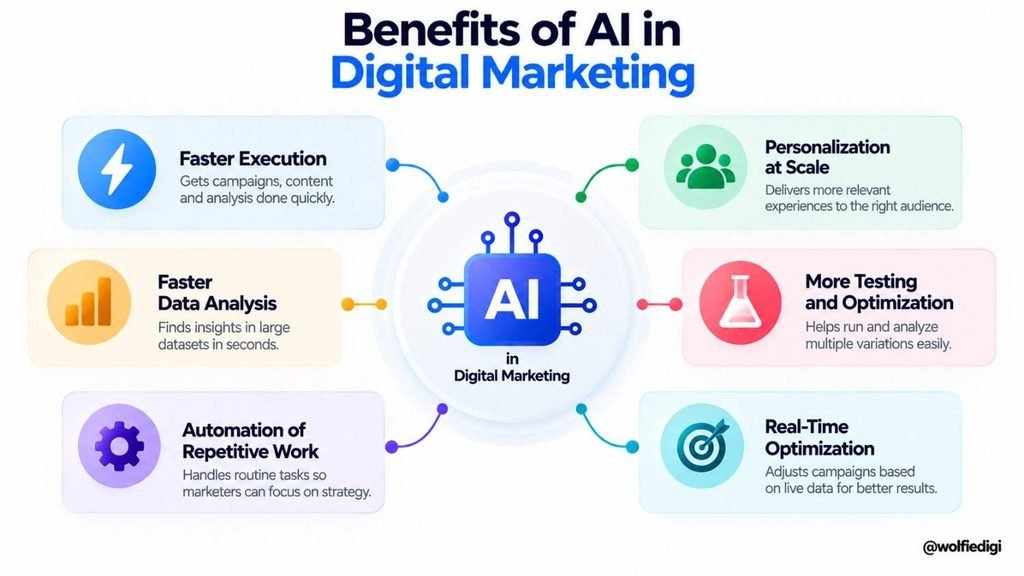
What Are the Benefits of AI in Digital Marketing?
AI can provide several practical benefits when used for appropriate marketing tasks.
Faster Execution
AI can reduce the time required for repetitive activities such as generating variations, summarizing data, organizing information, or creating first drafts.
Personalization at Scale
A human team cannot manually create a unique experience for every customer.
AI can help businesses personalize messages and recommendations using customer data and behavioral signals.
Faster Data Analysis
AI can process large datasets much faster than manual analysis in many situations.
This can help marketers identify unusual changes, patterns, or potential opportunities more quickly.
More Testing and Experimentation
AI can make it easier to generate variations of:
- Ad copy
- Email subject lines
- Landing-page messaging
- Social media content
- Creative concepts
This can give marketers more ideas to test, although the tests still need proper measurement.
Automation of Repetitive Work
AI can automate parts of recurring marketing workflows.
This allows marketers to spend more time on strategy, positioning, creative direction, customer understanding, and decision-making.
Real-Time Optimization
Some advertising systems can automatically adjust bids, targeting, placements, or creative combinations based on performance signals.
Google’s Performance Max is an example of this approach, using AI to optimize campaigns across Google’s advertising inventory based on the advertiser’s goals and inputs.
What Are the Limitations and Risks of AI in Digital Marketing?
AI is powerful, but it is not automatically accurate or appropriate.
AI Can Produce Incorrect Information
Generative AI can produce statements that sound convincing but are incorrect.
Marketing content therefore needs fact-checking, especially when it involves statistics, product claims, legal requirements, pricing, or technical information.
Poor Data Produces Poor Decisions
AI systems depend on the information available to them.
If customer data is incomplete, tracking is broken, or the data represents the wrong audience, an AI system can make poor recommendations.
Loss of Brand Consistency
AI-generated content can become generic if marketers rely on it without providing clear brand guidelines and human editing.
A business still needs a recognizable voice and a reason for customers to choose it.
Privacy and Data Concerns
AI marketing often depends on customer and behavioral data.
Businesses need to understand what information they collect, how it is used, where it is stored, and what privacy requirements apply to their customers.
This becomes especially important when AI systems are connected to customer databases, advertising platforms, and CRM systems.
Over-Automation
Automating a poor process does not make the process good.
If an AI system is allowed to make decisions without appropriate oversight, mistakes can scale quickly.
Generic Content
One of the biggest risks of generative AI is producing large amounts of content that says little that is original or useful.
AI can accelerate production, but it cannot automatically create genuine expertise, original experience, or a strong brand perspective.
What Are the Best AI Tools for Digital Marketing?
There is no single “best” AI tool for every marketer.
The right choice depends on the job, existing marketing stack, budget, data, and level of automation required.
Instead of choosing tools by popularity alone, it is more useful to evaluate them by function.
| Marketing task | Examples of AI-enabled tools or platforms | Typical use |
|---|---|---|
| General marketing assistance | ChatGPT, Gemini, Claude | Research support, brainstorming, drafting, analysis |
| SEO | Semrush, Ahrefs and other SEO platforms with AI features | Research, content analysis, optimization |
| Content creation | ChatGPT, Jasper, Copy.ai | Drafting, rewriting, content variations |
| Design | Canva and other AI-enabled design platforms | Visual concepts, editing, creative variations |
| Paid advertising | Google Ads, Meta Advantage+ | Targeting, bidding, creative optimization |
| Analytics | Google Analytics, BI platforms with AI features | Insights, anomaly detection, data analysis |
| CRM and automation | HubSpot, Salesforce and similar platforms | Lead scoring, personalization, workflow automation |
These examples should not be interpreted as a universal ranking. AI capabilities change quickly, and a tool that fits one workflow may be unnecessary for another.
For marketers choosing an AI tool, the more useful questions are:
- What specific problem does it solve?
- Does it integrate with existing tools?
- What data does it require?
- Can its output be reviewed?
- Does it provide enough control?
- How does it handle customer data?
- Can its impact be measured?
Current industry coverage also reflects this shift from simply collecting AI tools to evaluating whether they actually fit into real workflows and produce measurable value.
How Should Marketers Use AI Without Losing the Human Element?
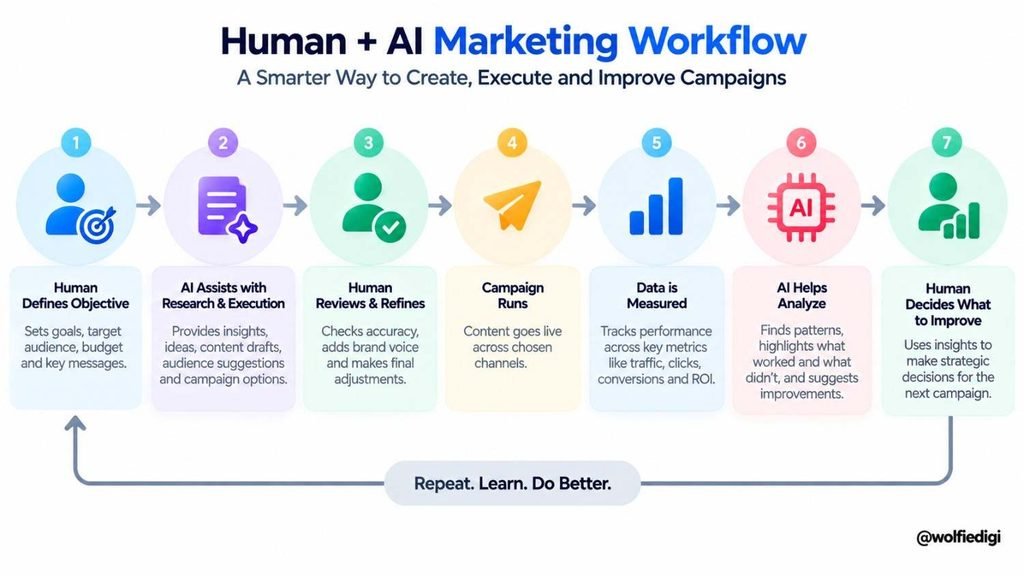
The most practical approach is AI-assisted marketing rather than AI-only marketing.
A useful workflow looks like this:
Human defines the objective → AI assists with research or execution → Human reviews the output → Campaign runs → Data is measured → AI helps analyze → Human decides what to change
For example, a marketer might ask AI to generate 20 headline ideas. That does not mean all 20 should be published.
The marketer should select the ideas that fit the audience, brand, offer, and campaign objective, then test them.
The same principle applies to articles, social posts, email campaigns, advertisements, customer responses, and analytics.
AI is most useful when it increases a marketer’s capability rather than removing the marketer from the process.
Is AI Going to Replace Digital Marketing?
No. AI is changing how digital marketing is performed, but it does not eliminate the need for marketing itself.
Marketing still requires decisions about:
- Who the business wants to serve
- What problem it solves
- How it should be positioned
- What makes the brand different
- Which customers are valuable
- What message should be communicated
- What business objectives matter
AI can assist with execution and analysis, but these decisions still require context and judgment.
The more realistic change is that some marketing tasks will become increasingly automated.
A marketer who previously spent several hours creating campaign variations may spend much less time doing the production work and more time reviewing, testing, and directing the system.
This changes the marketer’s role rather than making marketing unnecessary.
Recent industry reporting also points toward marketing roles shifting toward AI skills, data literacy, strategic understanding, and the ability to work effectively with AI systems rather than simply disappearing.
What Will the Role of AI in Digital Marketing Look Like Next?
AI is moving from isolated assistance toward deeper integration into marketing platforms.
Google’s 2026 advertising developments illustrate this direction. AI Max for Search is expanding how AI can handle search-term matching and creative generation, while Performance Max uses AI across bidding, audiences, creative, and optimization. Google is also testing advertising formats within AI Mode, where ads can appear within AI-generated responses.
Another development is the move toward more autonomous or agentic workflows.
Instead of simply asking AI to generate a report, a future marketing system may be able to monitor campaign performance, identify an opportunity, suggest an action, execute an approved change, and monitor the result.
That does not mean marketers should hand over every decision to an AI system.
As automation increases, the importance of defining permissions, quality controls, brand rules, privacy boundaries, and human approval points also increases.
How Can Beginners Start Using AI in Digital Marketing?
Beginners do not need ten AI subscriptions to get started.
A better approach is to choose one repetitive marketing task and test whether AI improves it.
For example:
- Choose a task such as content research, ad-copy variations, email subject lines, or reporting.
- Establish how you currently perform the task.
- Use one AI tool to assist with it.
- Review the output carefully.
- Compare the time and quality with your previous workflow.
- Measure whether the change actually improves the result.
- Keep the workflow if it works; change or remove it if it does not.
For example, a beginner could use AI to generate five versions of an email subject line, select the strongest two, and test them against the existing version.
This is more useful than adopting AI simply because it is popular.
Common Mistakes When Using AI for Digital Marketing
Using AI Without a Clear Goal
If there is no marketing objective, AI can generate a lot of activity without producing meaningful results.
Publishing AI Output Without Review
AI-generated content can contain factual errors, weak reasoning, repetitive language, or claims that do not fit the brand.
Using Too Many Tools
A complicated AI stack can create more work than it saves.
Giving AI Too Much Authority
Automated systems should have clearly defined boundaries, particularly when they can spend money, change campaigns, communicate with customers, or access sensitive information.
Measuring Output Instead of Results
Producing 100 social posts is not a marketing success by itself.
The important question is whether the work contributed to the actual objective.
Treating AI as a Strategy
AI is a technology, not a marketing strategy.
A business still needs a clear audience, positioning, offer, messaging, distribution plan, and measurement approach.
Final Thoughts
The role of artificial intelligence in digital marketing is expanding from simple task assistance to deeper involvement in content, advertising, analytics, personalization, automation, and customer interactions.
The most important change is not that AI can create more marketing material. It is that AI can increasingly analyze information, adapt marketing activity, and automate parts of decision-making at a scale that would be difficult to achieve manually.
But effective AI-driven digital marketing still needs human direction. Businesses need people who understand customers, strategy, brand positioning, data quality, privacy, and the difference between an impressive AI output and a result that actually matters.
The practical goal is therefore not to replace marketers with AI. It is to use AI where it improves speed, scale, analysis, or personalization while keeping human judgment where context, creativity, accountability, and strategy matter most.