
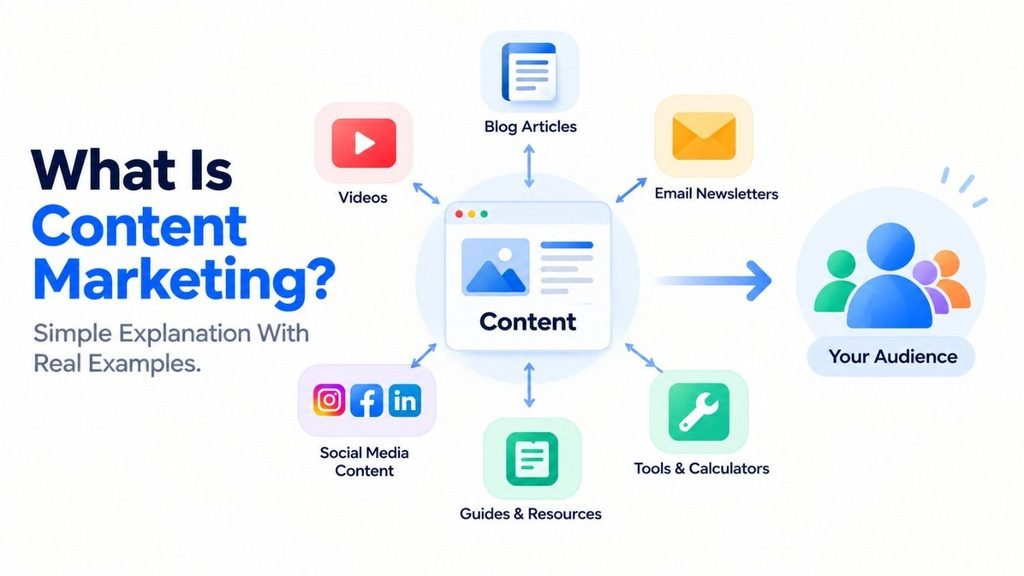
Content marketing is a way of attracting and building relationships with an audience by creating and distributing useful content. Instead of asking people to buy something every time a brand communicates with them, content marketing gives them information, answers questions, teaches them something, or helps them solve a problem.
A simple example is a fitness company publishing articles about healthy meal planning, videos showing beginner workouts, and an email newsletter with practical fitness tips. The company is not directly selling in every piece of content. It is building attention and trust with people who may eventually become customers.
That distinction is important. Content marketing is not simply creating content. It is using useful content deliberately to attract, engage, and retain an audience while supporting a business goal. The Content Marketing Institute similarly defines it as a strategic approach centered on valuable, relevant, and consistent content for a clearly defined audience.
What Is Content Marketing in Simple Words?
In simple words, content marketing means helping your target audience with useful content so they become familiar with, trust, and eventually choose your brand.
The content can answer a question, solve a problem, explain a complicated subject, entertain someone, or help them make a decision.
For example, imagine a company that sells accounting software to small businesses. Instead of only publishing posts saying “Buy our accounting software,” it could create:
- A guide explaining how to create an invoice
- A video showing how to track business expenses
- A calculator for estimating tax payments
- A checklist for preparing financial records
- An email newsletter with small-business finance tips
- A case study showing how a customer improved its accounting process
All of these pieces can attract people who have problems related to accounting. Some of those people may eventually need accounting software.
That is the basic idea behind content marketing: help first, sell when the audience has a reason to consider buying.
What Is Content Marketing With an Example?
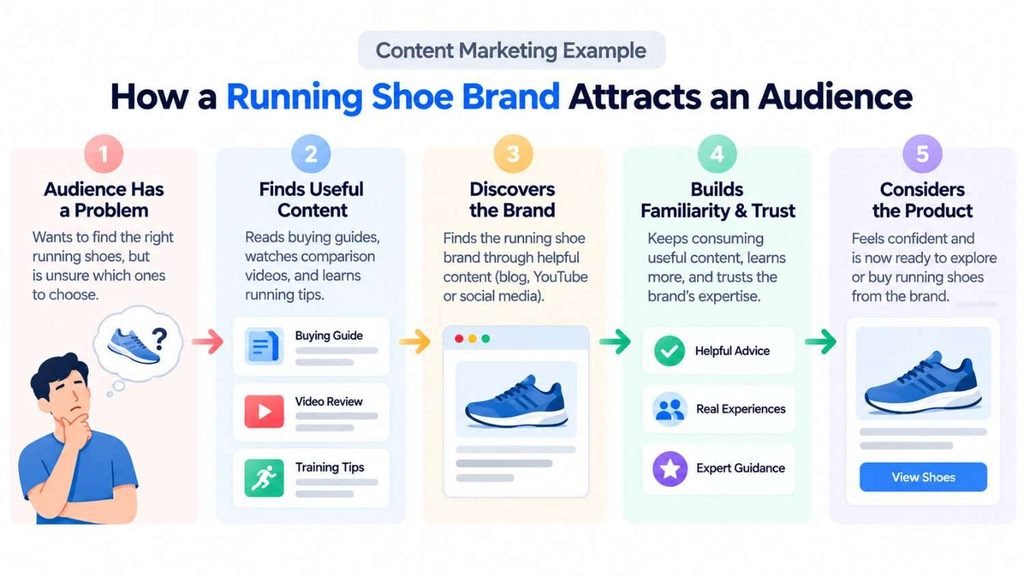
Consider a company that sells running shoes.
A traditional promotional message might say:
“Buy our new running shoes. They are comfortable, lightweight, and available now.”
That is advertising or promotional content.
A content marketing approach could look different. The company might publish an article called “How to Choose Running Shoes for Your First 5K”, create a video explaining common running-shoe mistakes, publish a comparison guide, and send training tips to people who subscribe to its newsletter.
Someone searching for information about their first 5K may discover the content before they are ready to buy anything.
Later, when that person needs running shoes, the company is no longer completely unfamiliar. The useful information they received may have helped establish trust and familiarity with the brand.
The content itself is not the product. The content is being used as a way to attract and develop an audience that could eventually create business value.
What Are Examples of Content Marketing?
Content marketing can take many forms. The best format depends on the audience, topic, business goal, and distribution channel.
Blog Articles and Guides
Blog posts are one of the most common forms of content marketing.
A travel company might publish destination guides. A software company might publish tutorials. A financial website might explain basic investing concepts.
The important part is not that the content is a “blog post.” It is that the article gives the target audience something useful.
Videos
Videos can demonstrate products, explain difficult concepts, answer questions, or tell stories.
For example, a home-improvement company could publish videos showing homeowners how to fix common household problems. The viewer gets useful information, while the company builds familiarity around its expertise.
Social Media Content
Social media content can include educational posts, short videos, visual explainers, customer stories, behind-the-scenes content, and discussions.
However, simply posting promotional messages every day is not automatically content marketing. The content should give the audience a reason to pay attention.
Email Newsletters
An email newsletter can deliver useful information directly to people who have chosen to hear from a brand.
For example, a marketing website could send subscribers a weekly email containing practical SEO tips, useful resources, and explanations of important changes in search.
Case Studies
Case studies show how a product or service helped solve a real customer’s problem.
They are particularly useful because they combine useful information with evidence. Instead of simply claiming that a service works, a case study can explain the situation, approach, implementation, and outcome.
Ebooks, Reports, and Original Research
Longer resources can be useful when a topic requires more depth.
A company might publish an industry report based on original research or create a detailed guide that helps its audience solve a recurring problem.
Original research can also give a brand something distinctive to contribute to the wider conversation instead of simply rewriting information that already exists.
Interactive Tools and Calculators
Interactive content can be particularly useful because the audience gets a practical result rather than just reading information.
A mortgage calculator, ROI calculator, assessment tool, or planning template can attract people with a specific problem and create a useful interaction with the brand.
Current content-marketing examples increasingly include interactive tools alongside traditional blogs, videos, newsletters, podcasts, webinars, and social content.
What Makes Something Content Marketing?
Not everything a company publishes is automatically content marketing.
A useful way to judge it is to ask four questions:
- Who is this content for?
- What problem, question, or interest does it address?
- Why would the audience choose to consume it?
- How does it support a broader business or marketing goal?
Suppose a shoe company publishes a post saying, “Our new shoes are now available.”
That may be useful as an announcement, but it does not necessarily demonstrate a content marketing approach.
Now suppose the company publishes “How to Choose Running Shoes for Different Types of Training.” It helps people make a decision, attracts an audience with a relevant need, and can naturally introduce the company’s products where appropriate.
The difference is not simply the length of the content. It is the purpose and value offered to the audience.
What Is a Content Marketing Strategy?
A content marketing strategy is the plan for using content to reach a specific audience and achieve defined marketing or business goals.
It answers questions such as:
- Who are we trying to reach?
- What problems or interests does this audience have?
- What do we want the content to achieve?
- What topics should we cover?
- Which formats should we use?
- Where will we distribute the content?
- How will we measure whether it is working?
For example, a SaaS company might want to generate more product trials from small-business owners.
Its strategy could focus on educational articles, comparison guides, webinars, customer case studies, and email content that address problems small-business owners face.
The important point is that the strategy comes before simply producing a large amount of content.
A current 2026 approach also needs to consider multiple discovery paths rather than assuming Google Search will be the only way people find content. Search, social platforms, email, video, communities, and other channels can all play a role depending on the audience.
A deeper step-by-step explanation of how to build a content marketing strategy deserves its own article, so this article focuses on the basic concept rather than turning into a full strategy guide.
How Does Content Marketing Work?
Content marketing usually works as a longer process rather than a single piece of content producing an immediate sale.
A simple model looks like this:
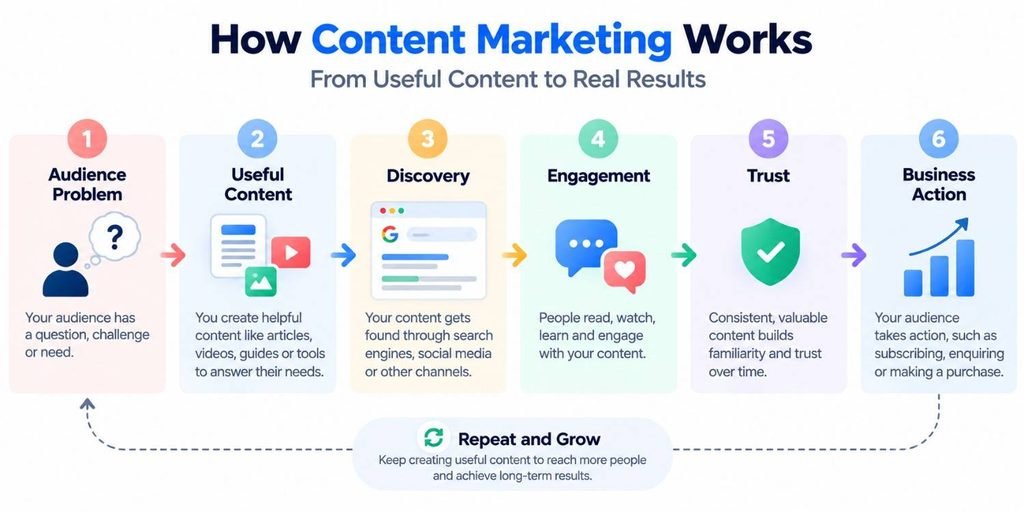
Imagine someone searches for “how to start a small business website.”
They find a helpful guide from a web-hosting company. The guide answers their questions without immediately pushing a purchase.
The reader may return for another article, watch a related tutorial, subscribe to the company’s email list, or explore its services. When they eventually need hosting, the company is already familiar to them.
This is why content marketing can influence different stages of the customer journey. Some content creates initial awareness, some helps people evaluate options, and some supports a purchase or strengthens an existing customer relationship.
Mailchimp similarly describes content marketing as a way to attract, engage, and retain an audience through formats such as articles, videos, podcasts, and other media.
What Are the Five Cs of Content Marketing?
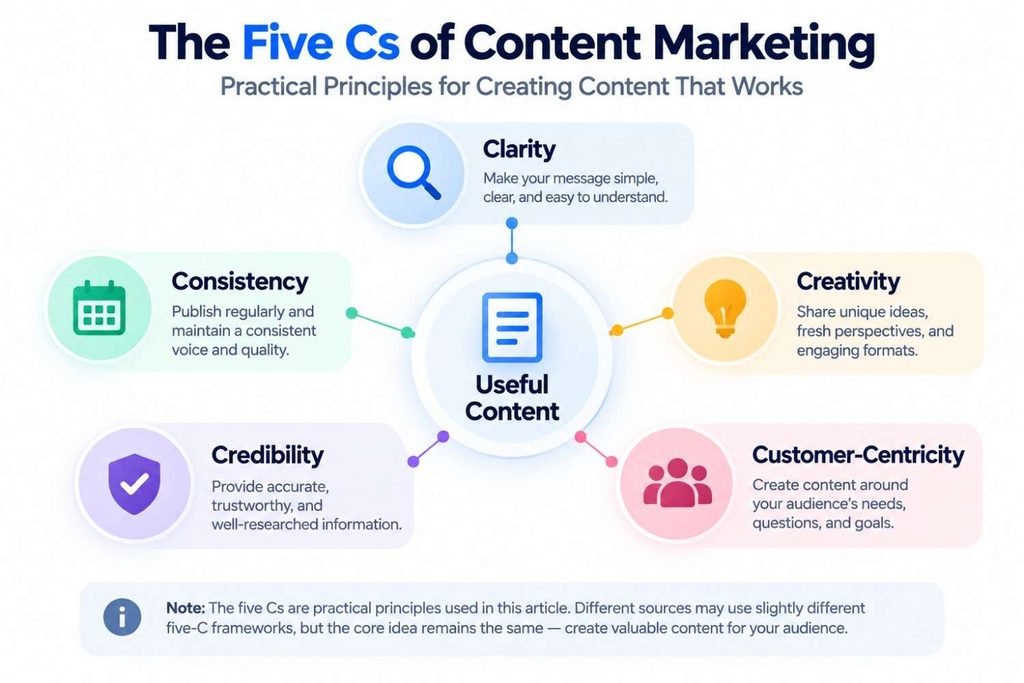
There is no single universally agreed version of the “five Cs” of content marketing. Different marketers use different C-based frameworks.
One commonly used practical version focuses on clarity, consistency, creativity, credibility, and customer-centricity. Other frameworks use terms such as concise, compelling, or call to action instead.
For beginners, the five principles can be understood like this:
1. Clarity
People should understand what your content is saying and why it matters.
Avoid unnecessary jargon and make the main point easy to find.
2. Consistency
Content marketing usually works better as an ongoing effort than as a one-time campaign.
Consistency does not mean publishing something every day. It means maintaining a reliable approach to topics, quality, audience, and distribution.
3. Creativity
Useful content still needs an interesting angle.
Creativity could come from the format, story, presentation, research, example, or way you explain a familiar problem.
4. Credibility
People need a reason to trust what they are reading or watching.
Clear evidence, accurate information, credible sources, real experience, transparent claims, and useful examples can strengthen credibility.
5. Customer-Centricity
The content should start with the audience’s needs rather than the company’s desire to promote itself.
A good question to ask is:
“What does my audience need help with?”
rather than:
“What do I want to tell people about my product?”
These principles are useful because they shift content marketing away from simply publishing more and toward creating content people have a reason to consume.
Content Marketing vs Advertising
Content marketing and advertising can both help a business attract customers, but they approach the audience differently.
Advertising generally pays for placement or distribution to promote a product, service, offer, or message.
Content marketing creates useful or interesting content that attracts and develops an audience over time.
For example, a fitness company could run a paid advertisement promoting a gym membership. At the same time, it could publish free workout guides and educational videos that help people learn how to exercise safely.
These approaches can work together. Content marketing does not have to replace advertising.
The distinction is mainly about what the audience is being given and how the business uses it to build a relationship over time.
Content Marketing and SEO: How Do They Work Together?
Content marketing and SEO are closely connected, but they are not the same thing. Our guide to what SEO is and why it is important explains how SEO helps people discover relevant content through search engines, while content marketing focuses on creating and distributing that content to attract and engage an audience.
For example, a company might research questions its audience searches for and create helpful articles around those questions. SEO can help those articles become discoverable, while content marketing determines the broader purpose behind creating and distributing them.
The two can also work beyond search. A useful article can be shared through email, social media, communities, sales conversations, or other channels.
That is why content should not be created only because a keyword has search volume. The stronger question is whether the topic is genuinely useful to the audience and supports a meaningful business objective.
Does AI Change Content Marketing?
AI has changed how marketers can research, draft, repurpose, analyze, and distribute content. It can help with tasks such as brainstorming ideas, summarizing research, creating content variations, or turning a long article into several shorter formats.
But AI-generated material by itself is not a content marketing strategy.
The difficult part of content marketing is still understanding the audience, choosing useful topics, developing a worthwhile point of view, checking facts, creating something genuinely valuable, and distributing it effectively.
This matters even more as the amount of automatically generated content increases. A brand that simply produces large volumes of generic AI-written articles may create more content without giving its audience a reason to care.
A better use of AI is to support the workflow while keeping human judgment, original insights, expertise, and quality control at the center.
What Are the Benefits of Content Marketing?
Content marketing can support several business goals when it is planned and executed well.
It Can Build Awareness
Useful content can introduce a brand to people who have not encountered it before.
It Can Build Trust
Regularly helping an audience solve relevant problems can demonstrate knowledge and reliability.
It Can Support Organic Discovery
Useful articles, videos, guides, and other resources can be discovered through search and other channels.
It Can Support Lead Generation
Some content can encourage people to subscribe, request information, start a trial, or take another meaningful action.
It Can Support Customer Retention
Content is not only for attracting new customers. Tutorials, educational resources, newsletters, product guidance, and customer education can continue providing value after a purchase.
It Can Compound Over Time
Some content can continue attracting attention long after its original publication, particularly when it remains useful and discoverable.
That does not mean every article will generate traffic indefinitely. Content can become outdated, competitors can publish better resources, and audience interests can change. Content marketing works best when useful assets are maintained rather than simply published and forgotten.
How Do You Start Content Marketing as a Beginner?
You do not need to start by publishing content on every platform.
Start with a specific audience and a specific problem.
For example, instead of deciding, “We need to create more content,” a small business could decide:
“We want to help first-time business owners understand digital marketing.”
From there, identify the questions that audience repeatedly asks. Then choose formats that fit those questions.
A practical starting process is:
- Define the audience.
- Identify their problems and questions.
- Choose a few topics worth owning.
- Select formats that suit the audience and topic.
- Create genuinely useful content.
- Distribute it where the audience actually spends time.
- Measure meaningful results.
- Improve the content based on what you learn.
The goal is not to create the maximum amount of content. It is to create content that earns attention from the people you actually want to reach.
Final Thoughts
Content marketing is the strategic use of useful content to attract, engage, and retain an audience while supporting broader marketing or business goals.
The simplest way to understand it is to think about the relationship between helpfulness and marketing. A company creates something its audience genuinely wants to consume, distributes it where that audience can find it, and builds familiarity and trust that can eventually contribute to business results.
The strongest content marketing is not necessarily the content with the most words, the biggest budget, or the highest number of views. It is content that understands the audience, provides real value, and has a clear reason for existing.
Once you understand that foundation, the next step is learning how to turn those ideas into a content marketing strategy that connects audience needs, topics, formats, distribution, and measurable goals.