
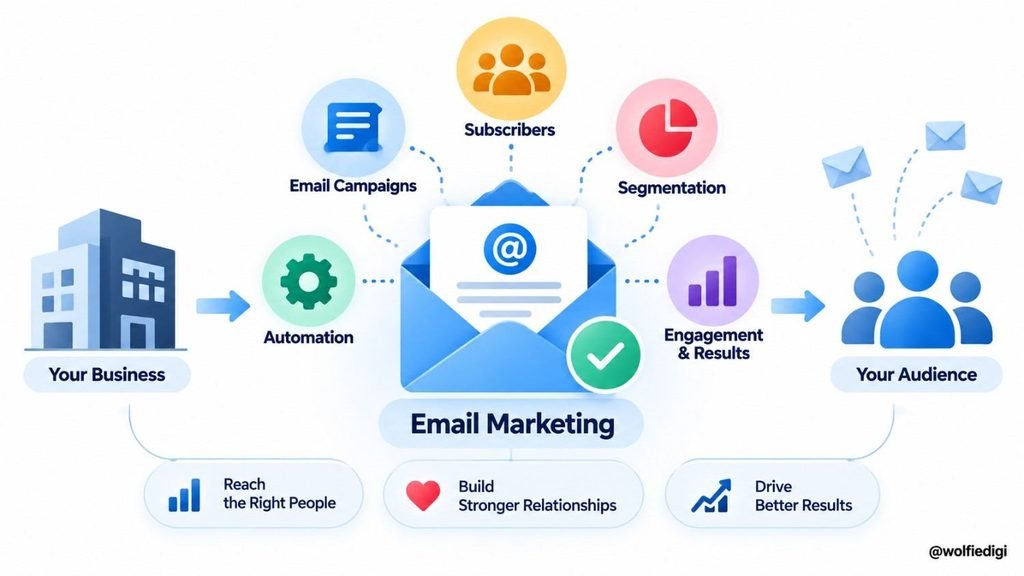
Email marketing is a digital marketing method that uses email to communicate with people who have chosen to receive messages from a business, organization, or creator. It can be used to share useful content, promote products or services, nurture leads, build customer relationships, and encourage specific actions.
Unlike a social media post that depends on a platform’s feed and distribution system, email gives a business a direct communication channel with its subscribers. But effective email marketing is not simply about sending more emails. The message needs to be relevant, timely, useful, and sent to people who have given appropriate permission to receive it.
What Is Email Marketing?
Email marketing is the practice of using email to communicate with an audience for a marketing or business purpose.
A business might send a newsletter to educate subscribers, a promotional email to announce a sale, a welcome email to introduce a new subscriber to its brand, or an automated email after someone takes a particular action.
For example, imagine you subscribe to an online clothing store’s newsletter. The company might send you a welcome message, new product announcements, seasonal offers, styling advice, and reminders about products you left in your shopping cart.
All of these can be part of an email marketing strategy.
The important distinction is that email marketing is generally based on an existing relationship with the recipient. People subscribe, sign up, or otherwise provide permission to receive certain types of communication. That makes the quality of the audience just as important as the size of the email list.
What Is Email Marketing in Simple Words?
In simple words, email marketing means using email to communicate with people who are interested in your business, content, products, or services.
Think of it as having a direct communication channel with your audience.
For example:
Someone discovers your website → subscribes to your email list → receives useful emails → becomes interested in your offer → eventually becomes a customer.
The relationship does not necessarily end after the purchase. The business can continue using email to provide helpful information, product updates, customer support messages, or relevant offers.
So, email marketing is not only about selling. It can also be about building and maintaining a relationship with an audience.
What Is Email Marketing All About?
At its core, email marketing is about delivering relevant messages to the right audience at an appropriate time.
Businesses use email at different stages of the customer journey. Someone who has just discovered a brand may need educational content, while an existing customer may be more interested in product updates, recommendations, or loyalty offers.
Email marketing also works alongside other digital marketing channels. For example, social media marketing can help a business attract attention and engage people on social platforms, while email can provide a more direct way to continue that relationship with subscribers.
This is why email should not be viewed as an isolated marketing activity. It can work together with SEO, content marketing, social media, paid advertising, and other channels as part of a broader digital marketing strategy.
How Does Email Marketing Work?
The basic email marketing process is easier to understand when you look at it as a sequence.
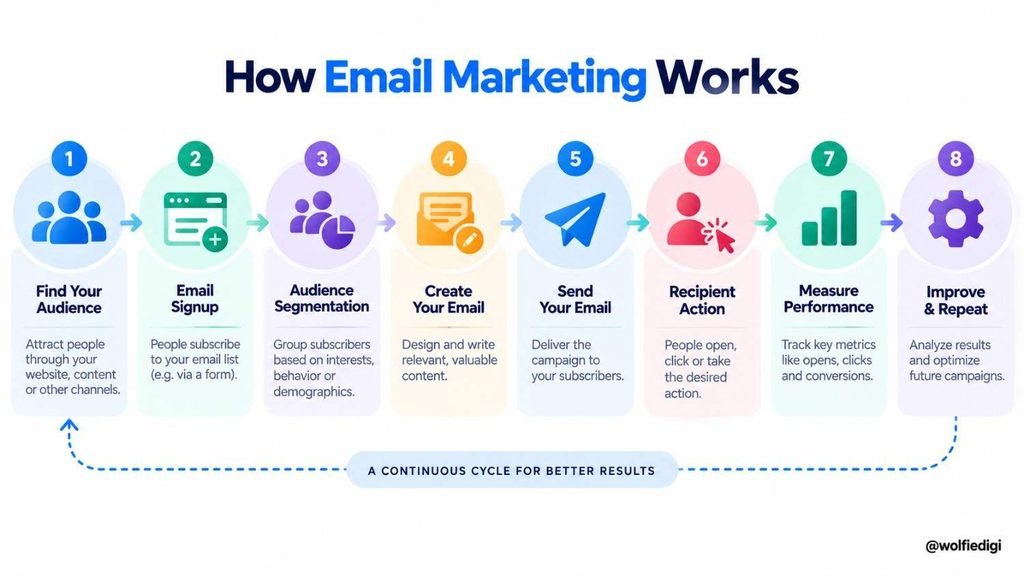
Audience → Signup → Segmentation → Email → Delivery → Action → Measurement
1. Build an Email List
The process starts with people joining an email list.
A business might collect subscribers through:
- Newsletter signup forms
- Website pop-ups
- Lead magnets
- Account registrations
- Event registrations
- Product updates
- Free resources or guides
The goal should not be to collect as many addresses as possible. A smaller audience that genuinely wants to hear from you can be more valuable than a large list of people who never engage.
Google also recommends obtaining clear consent for commercial or bulk email and providing recipients with a way to unsubscribe. Google’s email subscription guidelines
2. Segment the Audience
Not every subscriber has the same needs.
A business can divide its audience into groups based on information such as:
- Interests
- Previous purchases
- Location
- Customer status
- Website activity
- Email engagement
- Stage in the buying journey
This process is called email segmentation.
For example, an online store could send different emails to someone who has never purchased and someone who has already bought several products.
3. Create the Email
The next step is creating the actual message.
The content depends on the campaign’s purpose. It might educate the reader, introduce a product, announce an offer, share an article, or encourage a particular action.
A useful email normally has a clear purpose. The reader should be able to understand why they received the message and what, if anything, they should do next.
4. Send the Email
Businesses generally use an email marketing platform or email service provider to send campaigns.
These platforms can help marketers manage subscribers, create emails, schedule campaigns, automate messages, and analyze results.
Some emails are sent manually to a selected audience, while others are triggered automatically by specific actions.
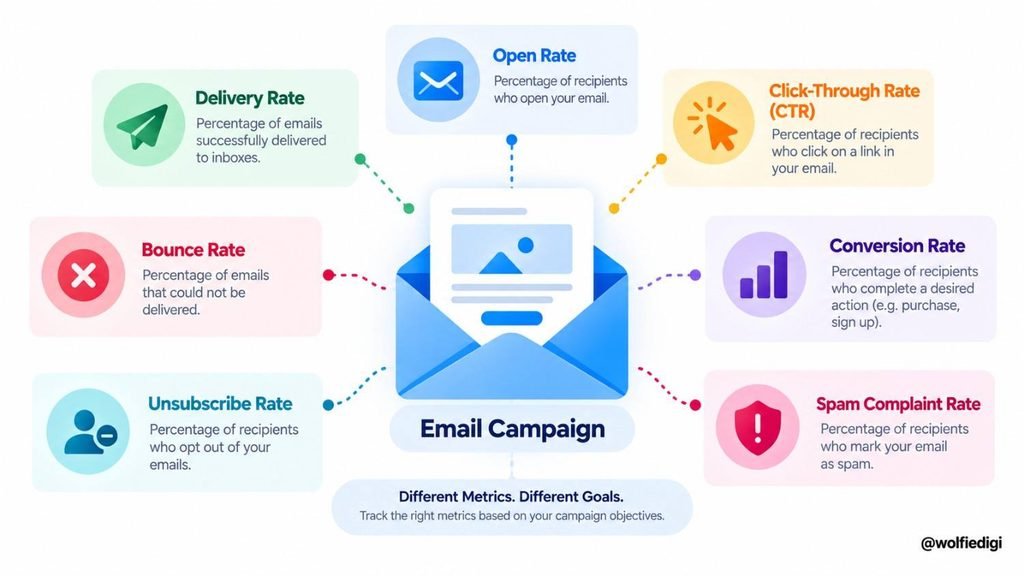
5. Measure What Happened
After an email is sent, marketers can examine its performance.
Depending on the campaign, useful metrics can include:
- Delivery rate
- Open rate
- Click-through rate
- Conversion rate
- Bounce rate
- Unsubscribe rate
- Spam complaints
The important metric depends on the campaign’s goal. A sales email might be judged by conversions, while a newsletter might focus more on engagement and clicks.
What Are the Main Types of Email Marketing?
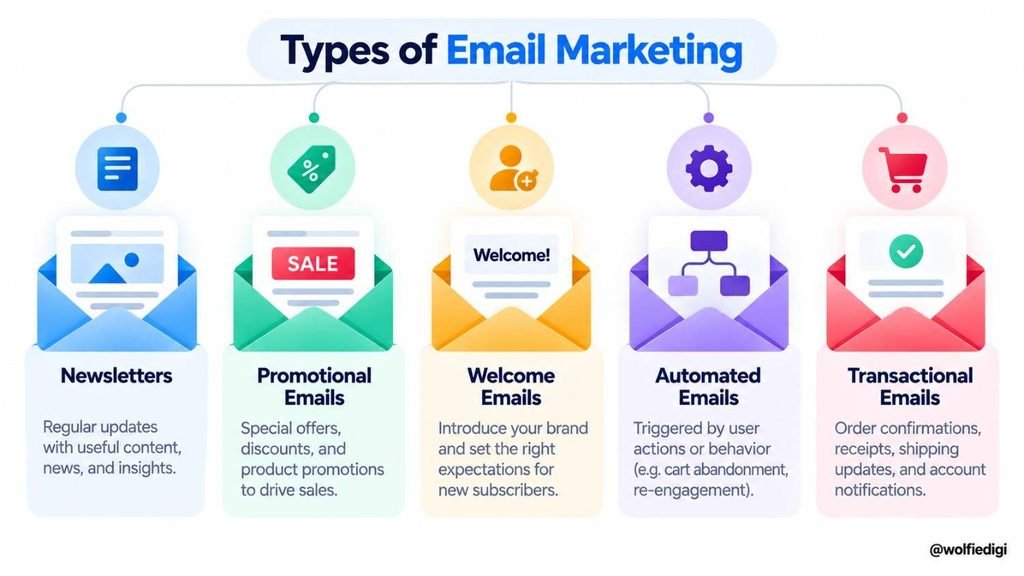
Email marketing includes several types of messages. Businesses often use more than one type because different messages serve different purposes.
Newsletters
Newsletters are recurring emails that provide useful information, updates, articles, insights, or curated content.
For example, a marketing website might send subscribers a weekly newsletter containing its latest articles and practical marketing tips.
Promotional Emails
Promotional emails are designed to encourage a commercial action.
They can be used for:
- Discounts
- Sales
- Product launches
- Special offers
- Seasonal campaigns
- Limited-time promotions
The strongest promotional emails are still relevant to the recipient rather than simply being sent because the business wants to sell something.
Welcome Emails
Welcome emails are sent after someone joins an email list.
A welcome email can introduce the business, explain what subscribers can expect, deliver a promised resource, or direct the subscriber toward a useful next step.
Automated Emails
Automated emails are triggered by a specific event, condition, or subscriber action.
Examples include:
- Welcome sequences
- Abandoned-cart emails
- Onboarding emails
- Product recommendations
- Re-engagement campaigns
- Follow-up sequences
Automation allows businesses to communicate at relevant moments without manually sending every individual email.
Transactional Emails
Transactional emails are generally triggered by a user’s action or a transaction.
Examples include:
- Order confirmations
- Receipts
- Shipping updates
- Password-reset emails
- Account notifications
These are different from promotional emails because their primary purpose is usually to provide information connected to an account or transaction.
What Are the Advantages of Email Marketing?
Email marketing has several advantages, which is why it remains an important part of many digital marketing strategies.
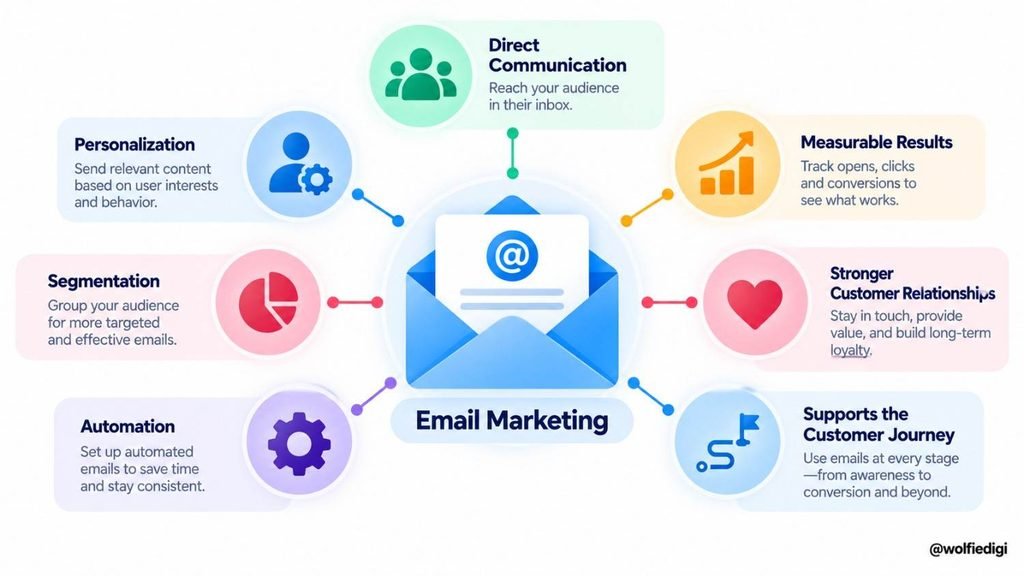
Direct Communication With Subscribers
Email provides a direct communication channel with people who have chosen to receive messages from a business.
A social media post may or may not reach every follower, while an email is delivered directly to the recipient’s inbox, subject to normal email delivery and filtering systems.
Personalization
Email campaigns can be personalized based on information about the recipient.
For example, a retailer can recommend products based on previous purchases, while a software company can send different onboarding content to new users and experienced customers.
Useful personalization is about making the message more relevant, not simply adding someone’s first name.
Audience Segmentation
Businesses can divide subscribers into groups and send different messages to each group.
This can make campaigns more relevant because a subscriber’s interests, previous behavior, and relationship with the business can be taken into account.
Marketing Automation
Email automation allows businesses to create messages that are triggered by specific events.
For example, when someone joins a mailing list, a welcome sequence can begin automatically. When a customer completes a purchase, a different sequence can provide relevant follow-up communication.
Automation can save time while allowing communication to happen at appropriate moments.
Measurable Results
Email marketing produces useful performance data.
Marketers can measure clicks, conversions, unsubscribes, bounces, and other campaign signals. These measurements can then be used to improve future campaigns.
For example, if an email receives many opens but very few clicks, the subject line may have attracted attention while the email content or call to action failed to move readers forward.
Supports Customer Relationships
Email is not limited to promotional campaigns.
Businesses can use it to educate subscribers, share useful information, answer common questions, provide updates, and stay connected with customers.
Over time, consistent and relevant communication can help maintain the relationship between a business and its audience.
Can Support Different Stages of the Customer Journey
Email can be used before, during, and after a purchase.
A potential customer might first receive educational content, then product information, followed by an offer. After purchasing, the same customer might receive onboarding information, product recommendations, or loyalty communication.
This makes email useful across multiple stages rather than for only one marketing objective.
What Are the Challenges of Email Marketing?
Email marketing also has limitations and operational challenges.
Deliverability
Sending an email does not guarantee that it will reach the inbox.
Emails can be delayed, rejected, or placed in spam depending on factors such as authentication, sender reputation, recipient engagement, and mailbox-provider policies.
For example, Google’s current requirements for senders to personal Gmail accounts include email authentication and other technical and sending-practice requirements. Bulk senders sending around 5,000 or more messages to personal Gmail accounts in a 24-hour period have additional requirements, including SPF, DKIM, DMARC, and one-click unsubscribe for relevant marketing messages. Google’s current email sender guidelines
Maintaining a Healthy Email List
Email lists naturally change over time.
Some subscribers stop engaging, change email addresses, or no longer want to receive messages. Continuing to send large volumes of irrelevant emails can hurt engagement and increase spam complaints.
Good list management is therefore part of email marketing, not an optional extra.
Creating Valuable Content
Having an email list does not automatically make a campaign successful.
People receive many emails every day, so businesses need to give subscribers a reason to pay attention. That might be useful information, a relevant offer, an interesting update, or something else the audience actually values.
Following Email Rules and Requirements
Email marketing must also respect applicable laws, regulations, and platform requirements.
Businesses need to understand requirements around consent, identification, unsubscribe mechanisms, and commercial communications in the markets where they operate.
Email Marketing vs Social Media Marketing
Email marketing and social media marketing can both help businesses communicate with audiences, but they work differently.
| Email Marketing | Social Media Marketing |
|---|---|
| Communicates directly with subscribers | Communicates through a social platform |
| Requires an email list | Builds an audience on social platforms |
| Can use detailed segmentation | Can use platform-based audience targeting |
| Supports automated email sequences | Supports content, engagement, and paid campaigns |
| Messages arrive in an inbox | Content appears within a social platform |
| Strong for ongoing direct communication | Strong for public reach and social interaction |
They do not have to compete with each other.
A business can use social media to attract people and encourage them to subscribe to an email list, then use email to continue communicating with those subscribers.
Is Email Marketing Still Important?
Email marketing has changed, but the basic principle remains the same: businesses need to provide relevant communication to people who have chosen to receive it.
Modern email marketing also requires more attention to technical delivery. Google currently requires email authentication for senders to Gmail accounts, while higher-volume senders have additional requirements involving SPF, DKIM, DMARC, spam rates, and unsubscribe functionality. Google’s sender requirements FAQ
This means learning email marketing today involves more than writing attractive emails. Marketers also need to understand audience permission, segmentation, automation, deliverability, measurement, and responsible sending practices.
How Do Beginners Start Email Marketing?
A beginner can start with a relatively simple system.
1. Choose a Specific Audience
Decide who you want to communicate with and what they are likely to find useful.
2. Give People a Reason to Subscribe
Offer something genuinely useful, such as educational content, updates, a resource, or another relevant benefit.
3. Choose an Email Marketing Platform
Use a platform that can manage subscribers, send campaigns, handle unsubscribes, and provide performance data.
4. Create a Welcome Email
Tell new subscribers what they can expect and deliver whatever you promised when they signed up.
5. Create Useful Regular Content
Choose a reasonable frequency and focus on providing value rather than sending emails simply because you have a schedule to maintain.
6. Measure Performance
Track the metrics that relate to your objective. If the goal is sales, look beyond opens and examine clicks and conversions.
7. Improve Over Time
Use campaign results to improve subject lines, content, segmentation, calls to action, and timing.
A beginner does not need a complicated funnel on day one. The important thing is to build a permission-based audience and learn what that audience actually responds to.
Common Email Marketing Mistakes
Buying Email Lists
Buying email lists can give a business many addresses, but those people did not necessarily ask to receive its messages.
This can create poor engagement and increase spam complaints. Google recommends obtaining clear consent before sending commercial or bulk email. Google’s bulk email best practices
Sending the Same Email to Everyone
Different subscribers can have different interests and needs. Sending identical messages to every person can reduce relevance.
Sending Too Many Promotional Emails
If every email is a sales pitch, subscribers may lose interest or unsubscribe.
A healthier approach is to make the overall communication useful rather than treating every message as an opportunity to sell.
Ignoring Unsubscribes
People should have a clear way to stop receiving marketing emails.
For relevant bulk marketing traffic, Gmail’s current requirements include one-click unsubscribe functionality. Google’s email sender guidelines
Ignoring Deliverability
A well-designed email is not useful if it repeatedly ends up in spam or fails to reach the recipient.
Technical authentication, sending practices, list quality, and spam rates can all affect delivery.
Final Thoughts
Email marketing is the use of email to communicate with an audience for marketing and business purposes. It can help businesses educate subscribers, promote products, nurture leads, maintain customer relationships, and encourage conversions.
The basic process is straightforward: build a permission-based audience, understand its needs, send relevant messages, and measure the results.
The biggest advantage of email marketing is not simply that a message can reach someone’s inbox. Its real value comes from being able to build an ongoing, measurable communication channel with an audience that has chosen to hear from you.