
Social media marketing can help businesses reach new audiences, build customer relationships, generate leads, and increase sales. However, publishing content regularly does not guarantee these results. Without a clear plan, businesses can spend hours creating posts without knowing whether their efforts contribute to their goals.
Effective strategies for social media marketing connect business objectives with audience needs, suitable platforms, valuable content, and measurable outcomes. Rather than trying to maintain a presence everywhere, businesses should prioritize the channels and activities most likely to reach their intended audience.
Whether you are a beginner, a small business owner, or a digital marketer managing client accounts, the goal is to build a repeatable process for planning, publishing, evaluating, and improving social media content.
This guide explains how to build a social media strategy, choose the right platforms, plan campaigns, use practical frameworks, and measure performance. It also includes a social media strategy example you can adapt to your business.

What Is a Social Media Marketing Strategy?
A social media marketing strategy is a documented plan explaining how a business will use social media to achieve specific marketing objectives. It defines the target audience, selected platforms, content approach, engagement methods, budget, and performance indicators.
For example, a local clothing brand might use Instagram to showcase products, Facebook to reach local customers, and WhatsApp to handle enquiries. Its strategy would connect these activities to a measurable objective, such as increasing qualified enquiries or online orders.
A social media strategy also differs from a content calendar. The strategy establishes the overall direction, while the calendar organizes individual posts, formats, responsibilities, and publishing dates.
Why Do Social Media Marketing Strategies Matter?
A clear strategy helps businesses make better decisions about where to invest their time and resources.
Its main benefits include:
- Clear direction: Every major activity supports a defined marketing objective instead of following random trends.
- Better audience understanding: Research helps marketers create content around real customer interests, questions, and problems.
- Consistent publishing: Planning ahead reduces last-minute work and makes content production more manageable.
- Stronger relationships: Responding to questions and feedback helps businesses maintain meaningful communication with their audiences.
- Measurable outcomes: Tracking relevant metrics helps marketers distinguish between content that attracts attention and activity that generates business value.
Social media can also support other digital marketing channels. For example, social content can introduce people to a brand, while email marketing can nurture interested prospects.
For a broader understanding of this channel, see What Is Email Marketing and What Are Its Advantages? How It Works.
12 Effective Strategies for Social Media Marketing
These strategies provide a practical foundation for businesses with different objectives, audiences, and resources. You do not need to implement every tactic immediately. Start with the activities most relevant to your goals.
1. Set Clear, Measurable Marketing Goals
Start by deciding what social media should accomplish.
Common objectives include increasing brand awareness, driving website traffic, generating qualified leads, increasing sales, building a community, and improving customer retention.
Avoid vague goals such as “get more engagement.” Instead, use the SMART framework: Specific, Measurable, Achievable, Relevant, and Time-bound.
For example:
- Vague goal: Improve Instagram performance.
- SMART goal: Generate 30 qualified enquiries from Instagram over the next 60 days.
The second goal defines a measurable business outcome and a timeframe. You can then choose the content, calls to action, and reporting methods that support it.
Choose one primary objective and a small number of supporting objectives. Trying to achieve everything through every post makes the strategy difficult to manage.
2. Understand Your Target Audience
Effective content starts with understanding the people you want to reach.
Research their interests, problems, purchasing behaviour, preferred content formats, and platform habits. Use existing customer questions, surveys, website analytics, sales conversations, and social media insights to gather evidence.
For example, a digital marketing agency might discover that small business owners are confused about why their websites receive traffic but generate few enquiries.
That insight can lead to useful content such as:
- An explanation of the difference between traffic and conversions.
- A checklist for identifying landing-page problems.
- A tutorial about improving calls to action.
- A guide to understanding website analytics.
These topics address an actual audience problem rather than relying entirely on popular trends.
Create a simple audience profile that describes whom you want to reach, what they need help with, and what information might help them make a decision.
3. Choose the Right Social Media Platforms
A business does not need to maintain an active presence on every social network. It needs to prioritize the platforms where its audience is accessible and its content can support the intended objective.
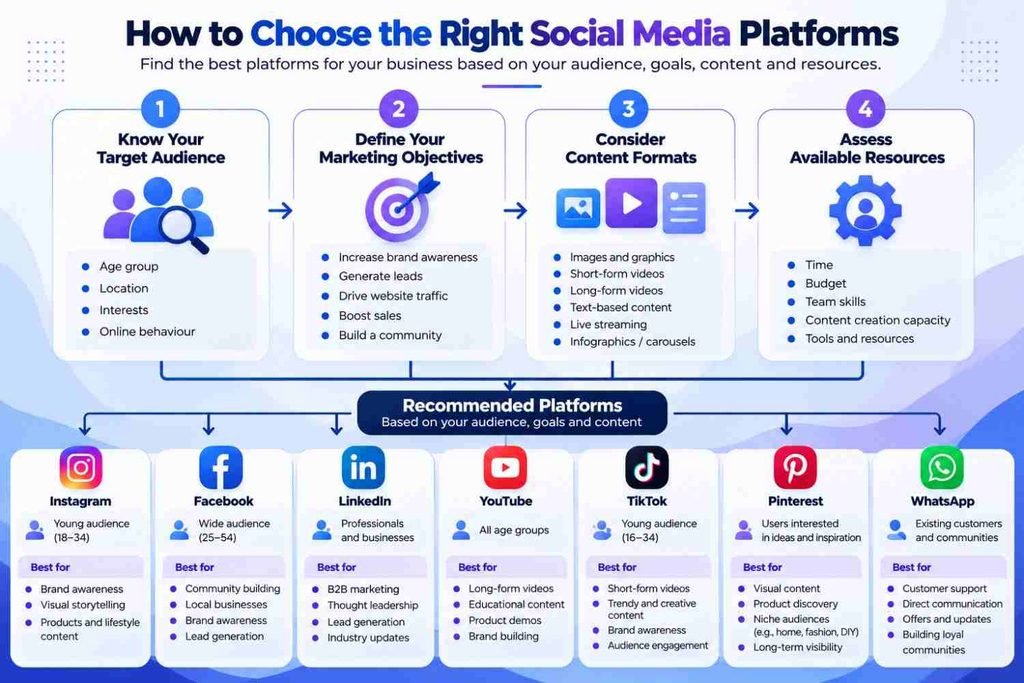
Consider these general platform use cases:
- Instagram: Visual storytelling, product discovery, short videos, and lifestyle content.
- Facebook: Local businesses, community engagement, events, and selected consumer audiences.
- LinkedIn: B2B marketing, professional services, recruitment, and industry insights.
- YouTube: Tutorials, demonstrations, educational videos, and product research.
- TikTok: Short-form video discovery and creator-led communication, where available.
- Pinterest: Visual inspiration, planning, and discovery in relevant niches.
- WhatsApp: Customer communication, support, and opt-in updates.
These are starting points, not guarantees of performance. Audience behaviour varies by industry, country, and demographic.
For businesses targeting India, consider the audience’s language preferences, location, platform usage, and purchasing habits before deciding where to invest resources.
Start with one or two priority platforms. Expand only when you have the resources to maintain quality and measure results.
4. Develop Clear Content Pillars
Content pillars are recurring themes that organize social media content. They help businesses maintain variety without losing focus.
A digital marketing agency, for example, might use five pillars:
- Educational content: SEO tips, marketing explanations, and tutorials.
- Problem-solving content: Common website mistakes and troubleshooting advice.
- Proof and credibility: Genuine case studies, documented results, and authorized customer feedback.
- Brand content: Team introductions, work processes, and company updates.
- Promotional content: Service explanations, consultations, and relevant offers.
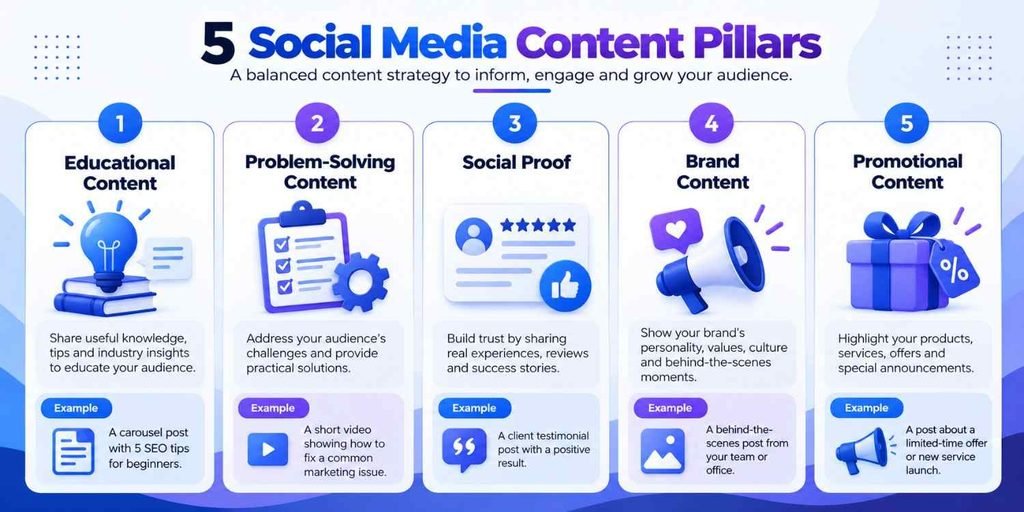
Each pillar should address a distinct audience need. For every theme, identify relevant topics, suitable formats, and the objective it supports.
For example, educational content might build awareness, while a service demonstration could help interested prospects evaluate an offer. This balance prevents the account from becoming a constant stream of promotions.
5. Create Valuable, Platform-Specific Content
Give people a reason to stop scrolling, continue watching, save a post, share it, visit your website, or contact your business.
Useful formats include:
- Carousels that explain a process step by step.
- Short videos that demonstrate a product or solve a specific problem.
- Tutorials that answer common customer questions.
- Infographics that simplify complex concepts.
- Customer stories based on genuine, authorized experiences.
- Polls and questions that encourage meaningful participation.
- Longer educational videos for subjects that need more explanation.
Do not assume that the same content should be published in exactly the same format everywhere.
A detailed LinkedIn post might become an Instagram carousel, a short video, and a longer YouTube tutorial. The core idea can remain consistent while the presentation changes to suit each platform.
Repurposing content saves time, but copying identical captions and creative assets everywhere without considering context can make the content less relevant.
Prioritize usefulness over production complexity. A clear demonstration that answers a real customer question can be more valuable than a polished video without a meaningful message.
6. Build a Realistic Social Media Content Calendar
A content calendar organizes what will be published, where it will appear, and when it will go live. It should make execution easier, not become an administrative burden.
A practical calendar can include the publishing date, platform, content pillar, topic, format, caption, call to action, owner, and publication status.
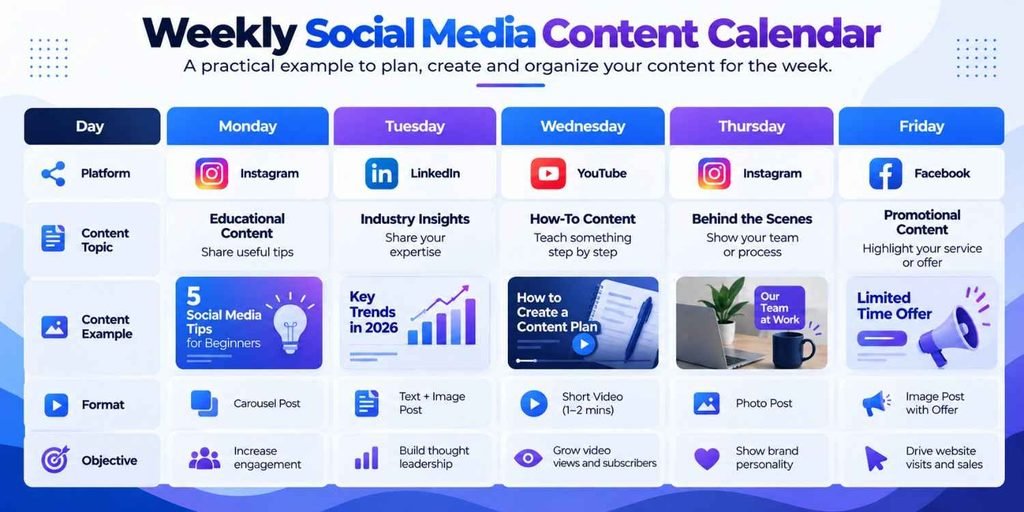
Choose a posting frequency your team can maintain without reducing quality or neglecting audience interactions.
For a small business, three strong feed posts per week could be a reasonable starting experiment. This is not a universal recommendation. The appropriate frequency depends on the platform, audience, available resources, and results.
Plan content at least a week or two ahead when possible, but leave room for relevant industry developments and audience questions.
7. Use Short-Form Video Strategically
Short-form video can help businesses demonstrate products, explain ideas, and introduce their brand to new audiences. However, publishing videos simply because the format is popular is not a strategy.
Use a straightforward structure:
- Hook: Introduce the problem, question, or benefit quickly.
- Value: Deliver the explanation, demonstration, or story.
- Next step: Tell viewers what to do if they want to continue.
For example, a digital marketing agency could create a video titled “Three reasons your website gets traffic but no leads.”
The video could explain an unclear call to action, a poorly matched landing page, and a complicated enquiry form. The closing message could direct viewers to a related checklist.
Use subtitles when they improve accessibility, keep each video focused on one main idea, and make important information understandable without unnecessary audio dependence.
Measure relevant outcomes such as watch time, completion, shares, profile visits, and qualified enquiries. Views alone do not establish commercial success.
8. Build Engagement and Community
Social media is not just a publishing channel. It is also a place where customers ask questions, share opinions, and communicate directly with businesses.
A practical engagement process should include:
- Responding to relevant comments and messages.
- Answering recurring questions through useful content.
- Acknowledging customer feedback.
- Participating in relevant industry discussions.
- Following up on legitimate product or service enquiries.
- Directing sensitive customer issues to an appropriate private channel.
If several team members manage an account, define who handles customer questions, complaints, and sales enquiries.
Avoid generic comments and artificial interactions that add little value to the conversation. Meaningful engagement is more useful than chasing a high interaction count without considering relevance.
9. Use Hashtags, Keywords, and Social Search Thoughtfully
People discover content through platform searches, recommendations, and their existing networks. Clear descriptions help them understand what a post covers and whether it matches their interests.
For example, a post about local SEO could naturally mention “Google Business Profile optimization,” “local SEO checklist,” and “improving local visibility” where relevant.
Apply these practices:
- Write descriptive captions.
- Include relevant terminology naturally.
- Use clear video titles and on-screen text.
- Use hashtags selectively when they provide useful context.
- Write descriptive alt text for meaningful images where supported.
- Make profile descriptions explain what the business offers and whom it serves.
Hashtag limits and discovery mechanisms vary by platform and can change. Do not assume that adding more hashtags automatically increases reach.
The goal is to make content relevant and understandable, not to turn captions into lists of disconnected keywords.
10. Collaborate With Relevant Creators and Partners
Creator collaborations can help businesses reach audiences that may not otherwise encounter their content.
Evaluate potential partners based on audience relevance, geographic fit, engagement quality, content quality, brand suitability, pricing, and rights to reuse their content.
For example, a local fitness business may benefit more from a smaller creator whose audience lives nearby than from a larger creator with an unrelated or geographically dispersed audience.
Define the collaboration objective before agreeing to a partnership. Depending on the goal, measure qualified reach, referral traffic, enquiries, sales, or cost per acquisition.
Do not rely solely on follower counts or likes to judge whether a collaboration was worthwhile. Follow applicable sponsorship disclosure requirements as well.
11. Combine Organic Content With Paid Social Advertising
Organic social media can support education, community engagement, brand familiarity, and ongoing communication. Paid advertising can help businesses reach selected audiences, promote offers, generate leads, or test creative variations.
A practical approach is to use organic content to understand which topics and messages generate meaningful interest, then consider paid promotion when there is a clear objective and sufficient evidence to justify spending.
Before launching a paid campaign, define its objective, audience, creative, budget, destination page, conversion tracking, and criteria for improving or stopping the campaign.
A post that receives many likes is not automatically a good advertisement. Paid performance also depends on the offer, audience, creative, landing-page experience, and conversion process.
For a deeper understanding of paid promotion, See What Is PPC Advertising in Digital Marketing? How It Works, Benefits & Campaigns .
Social advertising is a distinct part of paid media, and understanding broader campaign concepts can help marketers make better decisions about budget and performance.
12. Measure Performance and Improve the Strategy
Measurement helps marketers distinguish between content that attracts attention and activity that contributes to business objectives.
Choose metrics that match the goal:
- Awareness: Reach, impressions, and relevant video views.
- Engagement: Shares, saves, comments, and engagement rate.
- Traffic: Link clicks, website sessions, and landing-page visits.
- Lead generation: Qualified leads, enquiry rate, and cost per lead.
- Sales: Purchases, conversion rate, and customer acquisition cost.
- Retention: Repeat purchases and returning customers.
A post with lower reach may generate more qualified leads than a viral post that attracts people with no interest in the product.
For website campaigns, use UTM parameters in destination URLs where appropriate. Google’s Campaign URL Builder and UTM documentation explains how parameters such as utm_source, utm_medium, and utm_campaign help identify campaign traffic in Google Analytics.
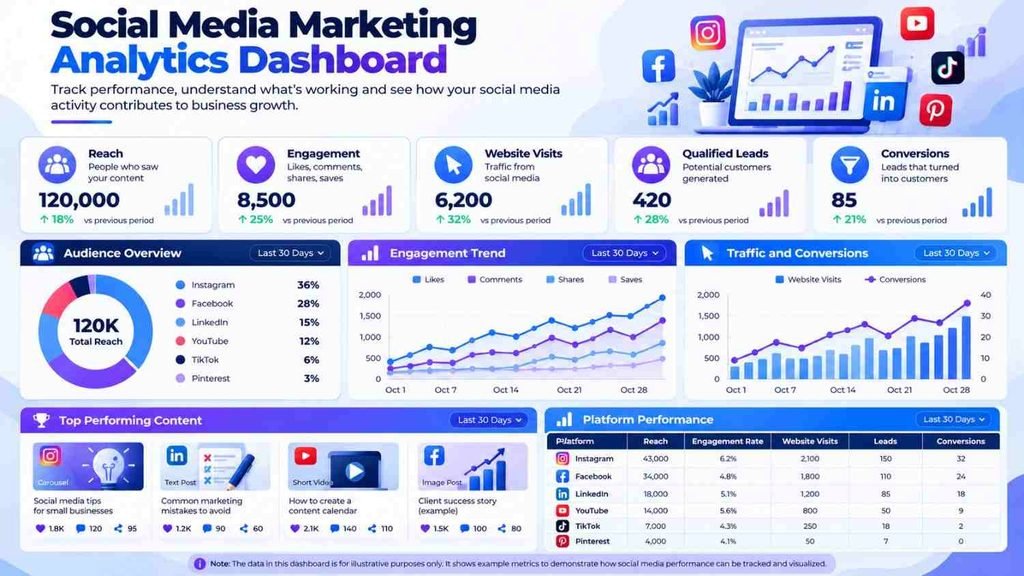
Review performance consistently and compare similar posts or campaigns. Consider the audience, content format, paid promotion, and objective before deciding what worked.
Use the findings to improve the next cycle rather than changing the entire strategy after one weak post.
How to Build a Social Media Strategy Step by Step
The strategies above explain what businesses can do. The following process shows how to put those activities into practice without creating an unnecessarily complicated plan.
Step 1: Audit Existing Accounts
Review your active accounts and document their current performance.
Look at audience characteristics, publishing frequency, best-performing posts, engagement trends, website visits, and enquiries where measurable.
If sufficient data is available, review the previous 60–90 days to identify recurring patterns. For new accounts, document the starting position and use the first few weeks to establish a baseline.
Do not judge the strategy by one unusually successful post. Look for patterns across multiple posts and formats.
Step 2: Research Competitors and Identify Gaps
Select three to five relevant competitors or comparable brands. Examine their content themes, formats, audience discussions, calls to action, and topics that receive meaningful engagement.
Look for questions they have not answered well or subjects that could benefit from clearer explanations and practical examples.
For instance, if several digital marketing agencies publish generic SEO tips, an opportunity might be to create detailed troubleshooting tutorials or explain how to interpret analytics data.
Competitor research can reveal content opportunities, but public engagement figures do not reveal a competitor’s complete sales performance or advertising costs. Use the research to inform your decisions rather than copy another brand’s strategy.
Step 3: Define Positioning and Priorities
Write a short statement explaining whom your content serves and why it matters.
For example:
“Our content helps small business owners understand digital marketing, identify common website problems, and make better decisions about online growth.”
Use this statement to guide platform selection, content topics, and communication style.
Then choose your priority platforms and assign each one a clear role. Instagram might support visual education, while LinkedIn could focus on professional insights and business-related problems.
Step 4: Turn Content Pillars Into a Publishing Plan
Choose three to five content pillars and brainstorm specific topics within each one.
For a digital marketing education website, these might include SEO, paid advertising, analytics, social media marketing, and AI applications.
A single topic can produce several formats. For example, “social media engagement” could become a carousel explaining engagement rate, a short video about common mistakes, and a tutorial showing how to review platform insights.
Plan content ahead of time, assign responsibilities, and maintain a manageable production schedule.
Step 5: Test and Refine
Test a limited number of variables, such as different hooks, formats, or calls to action. Where possible, keep other conditions similar so you can interpret the results more reliably.
If educational carousels consistently generate more saves than promotional graphics, investigate whether the audience values practical explanations. You could then create related content while monitoring whether it also supports your business objectives.
Review the strategy monthly and conduct a more substantial review quarterly or when business objectives change.
What Are the 7 C’s of Social Media Strategy?
There is no single universally standardized version of the 7 C’s used across every marketing source. One practical interpretation is Content, Context, Conversation, Community, Connection, Consistency, and Conversion.
These concepts provide a useful planning framework, but they should not be presented as the only authoritative definition.
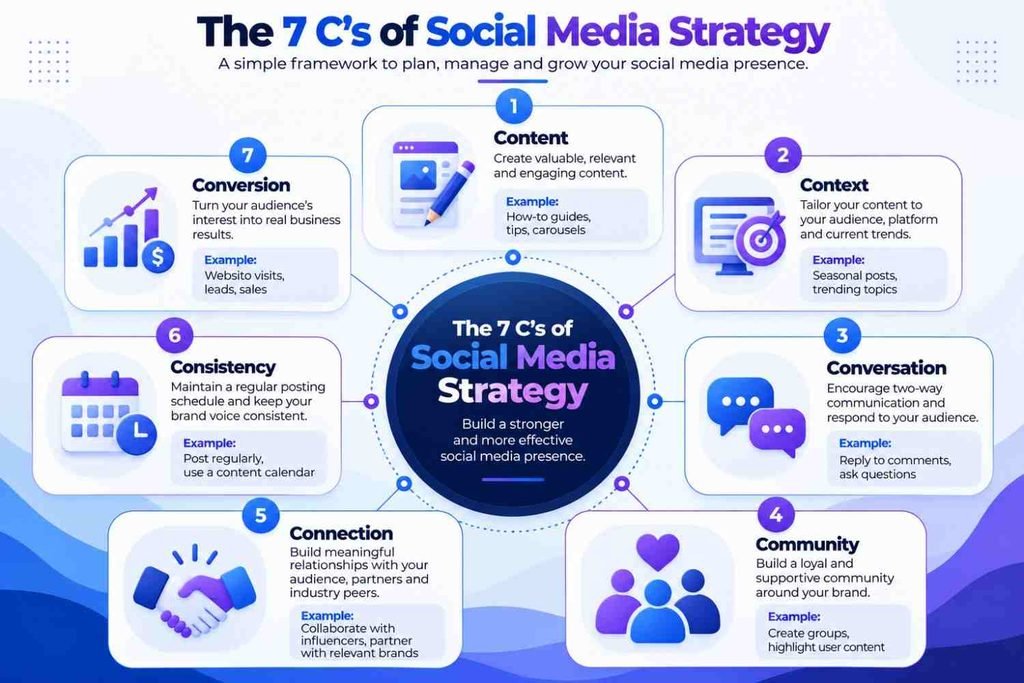
- Content: Publish useful information that addresses audience needs.
- Context: Adapt the message to the audience and platform.
- Conversation: Respond to questions and encourage meaningful discussion.
- Community: Support relationships among people with shared interests.
- Connection: Build relationships between the audience and brand.
- Consistency: Maintain a recognizable voice and sustainable publishing schedule.
- Conversion: Encourage an appropriate next action, such as an enquiry, signup, or purchase.
Consider a digital marketing agency publishing a social media audit checklist. The checklist provides useful content, is designed for small business owners, invites relevant discussion, and gives readers an opportunity to request further help.
The framework encourages marketers to consider the entire audience experience rather than focusing only on content production.
What Is the 5-5-5 Rule for Social Media?
The 5-5-5 rule is an informal planning approach whose meaning varies across marketing discussions. There is no single universally accepted definition.
One interpretation is to identify five relevant accounts, make five meaningful interactions, and create five opportunities for content or relationship building within a defined period. Other versions use the numbers to organize content themes or posting activities.
Because the framework is not standardized, treat this as a practical adaptation rather than an official platform rule.
For example, a small business could identify five relevant customers, creators, or industry accounts; leave five thoughtful comments or answer five relevant questions; and create five useful opportunities for connection through content, resources, or follow-ups.
These numbers are illustrative targets, not performance benchmarks. The quality and relevance of each interaction matter more than reaching an arbitrary count.
Social Media Strategy Example: A Digital Marketing Agency
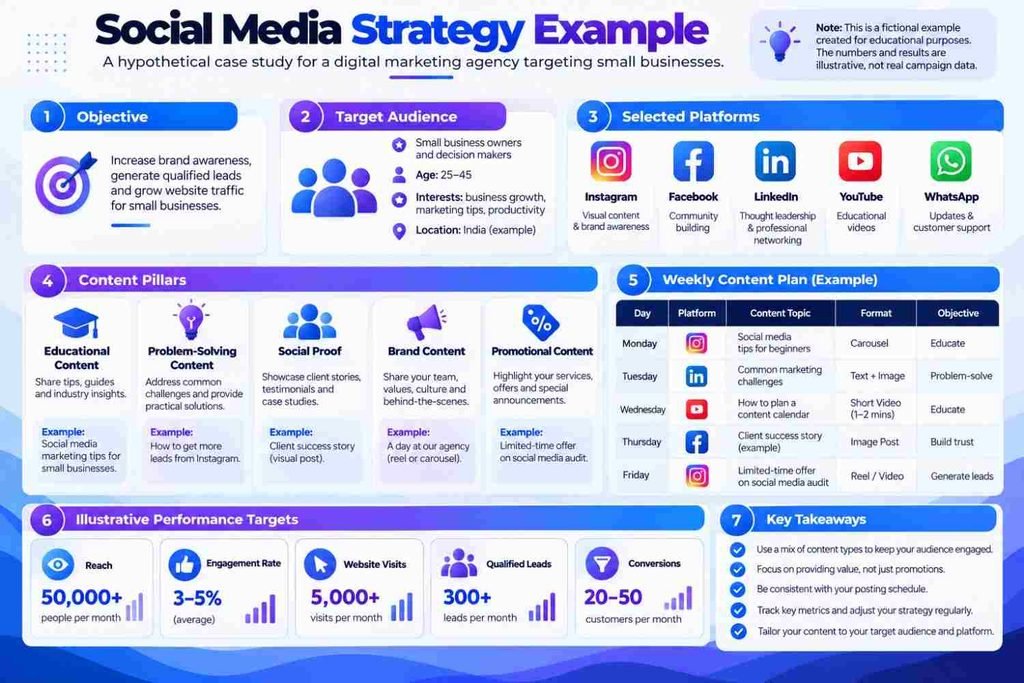
Imagine a fictional digital marketing agency that wants to generate more qualified enquiries from small business owners. It has limited resources and currently publishes irregularly on Instagram and LinkedIn.
The following example shows how the agency could structure its first 30 days. The targets are hypothetical planning assumptions, not actual results or industry benchmarks.
Define the Objective and Audience
The agency sets a target of generating 12 qualified enquiries in 30 days.
Its audience consists of small business owners who need help with SEO, paid advertising, or website performance but do not have an in-house marketing team.
Their common concerns include limited budgets, confusing reports, and uncertainty about which marketing activities generate leads.
Assign Roles to Each Platform
- Instagram: Short educational videos, carousels, and practical marketing tips.
- LinkedIn: Detailed explanations, business-focused insights, and relevant case studies.
The agency will focus on these two channels during the initial test rather than spreading resources across several additional platforms.
Plan the Content
The agency selects four themes: SEO education, marketing troubleshooting, genuine case studies, and service-related content.
A sample week might include an Instagram carousel about common SEO mistakes on Monday, a LinkedIn post about website conversions on Tuesday, a short educational video on Wednesday, an audit checklist on Thursday, and a consultation offer on Friday.
The agency can adjust this schedule according to production capacity and audience response.
Measure the Results
At the end of each week, the agency reviews reach, relevant engagement, website sessions, enquiry submissions, qualified leads, and consultations booked.
Suppose Instagram generates many profile visits but few enquiries, while LinkedIn produces fewer visits and more qualified leads. The agency should investigate audience quality, messaging, and landing-page performance before deciding where to invest more time.
The important lesson is that the best strategy is not necessarily the one generating the most engagement. It is the one that uses resources effectively to achieve the intended business objective.
How Do You Create a Social Media Campaign?
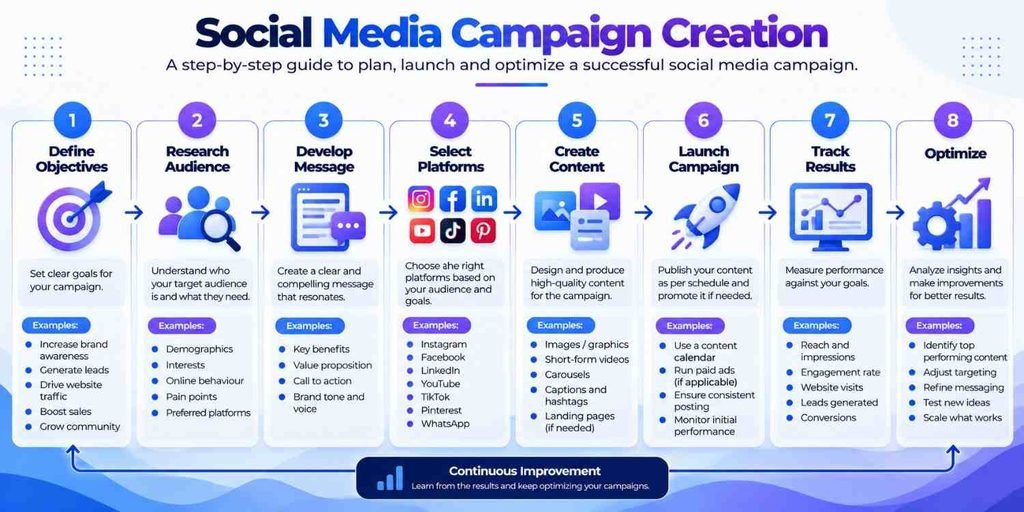
A social media strategy establishes long-term direction, while a campaign is a focused set of activities designed to achieve a specific objective within a defined period.
For example, a business might run a campaign to launch a product, promote a webinar, increase registrations, or generate service enquiries.
1. Define the Campaign Objective
Choose one primary outcome, such as generating 50 webinar registrations or attracting qualified enquiries. Make the target measurable and realistic for the campaign’s duration and budget.
2. Identify the Target Audience
Define the people most likely to respond. Consider their needs, location, buying stage, interests, and previous interactions with the business.
3. Develop the Campaign Message
Identify the main problem, benefit, or offer the campaign will communicate.
A campaign promoting an SEO audit, for example, might focus on helping small businesses identify technical issues that affect their website’s search visibility.
4. Select Platforms and Formats
Choose channels based on audience fit and campaign objectives. A webinar campaign might use LinkedIn posts, short educational videos, and targeted paid promotion.
5. Prepare Content and Tracking
Create the posts, videos, captions, landing page, and calls to action. Establish a schedule for the launch, supporting content, reminders, and final promotion.
Ensure that the destination page works properly on mobile devices and provides a clear next step.
6. Launch, Monitor, and Optimize
Track whether the intended audience responds, whether visitors complete the desired action, and whether the campaign meets its objective.
Example: A Campaign to Promote a Free SEO Checklist
A fictional digital marketing agency plans a seven-day campaign to promote a free website SEO checklist.
Its objective is to generate 100 downloads from small business owners using LinkedIn and Instagram. The campaign includes an educational carousel, a short video, a checklist preview, and a reminder post.
Every asset directs interested users to a landing page with a clear download action. The agency measures landing-page visits, downloads, and conversion rate rather than relying solely on views or likes.
If the agency also uses email to nurture interested prospects, Email can support follow-up communication when people have appropriately opted in.
Useful Tools for Social Media Marketing
The right tools can reduce manual work, improve collaboration, and make performance easier to evaluate. Start with the tools that solve your immediate problems rather than paying for features you do not need.
- Meta Business Suite: Manage supported Facebook and Instagram activities, including publishing, messages, and available insights.
- Canva: Create social graphics, carousels, and reusable brand templates.
- Buffer: Organize social media publishing and manage supported channels.
- Google Analytics: Evaluate website traffic and conversions from social media campaigns.
- Native platform analytics: Review platform-specific reach, engagement, and other available performance metrics.
- Spreadsheets or project-management tools: Track content ideas, deadlines, approvals, and publishing status.
Tool capabilities and pricing can change, so check the provider’s current documentation before relying on a specific feature.
A beginner managing two social accounts may only need native analytics, a content calendar, and a design tool. More advanced scheduling and reporting systems can be added as the workload grows.
How Artificial Intelligence Can Support Social Media Marketing
Artificial intelligence can assist with planning and production, but its output should be reviewed before publication.
Useful applications include brainstorming content ideas, developing alternative hooks, repurposing long articles into shorter formats, organizing content pillars, summarizing performance reports, and drafting responses for human review.
For example, an AI tool can help turn an article about technical SEO into a carousel outline, a short video script, and a LinkedIn post. A marketer should verify the facts, adapt the formats to their audiences, and remove unsupported claims.
Avoid publishing generic AI-generated content simply to increase posting frequency. It can create repetitive messaging and introduce errors that damage credibility.
For a broader discussion, See The Role of Artificial Intelligence in Digital Marketing: Uses, Examples & Tools
AI is most useful when it supports a clear editorial process. Audience understanding, strategic judgment, accuracy, and meaningful customer interaction still require attention.
Common Social Media Marketing Mistakes to Avoid
Even a well-organized strategy can underperform if its execution is weak.
Posting Without a Clear Purpose
Content should support an audience need or business objective. If a post has no meaningful connection to either, reconsider its place in the plan.
Trying to Use Every Platform
Maintaining too many accounts can lead to inconsistent publishing and weak execution. Prioritize channels where audience needs and business objectives align.
Copying Competitors
Competitor research can reveal opportunities, but copying another brand does not establish differentiation. Use the research to identify unanswered questions and create a more useful response.
Measuring Success Only Through Likes
Likes do not necessarily demonstrate qualified interest, website traffic, or revenue. Measure outcomes that match your objectives.
Ignoring Comments and Messages
Publishing content without responding to relevant audience interactions misses opportunities to answer questions and understand customer needs.
Changing the Strategy Too Quickly
One weak post is not enough evidence to abandon a content theme. Review a reasonable sample of results and consider the influence of audience, format, timing, and campaign conditions.
Failing to Track Business Outcomes
If social media is intended to generate enquiries, establish how those enquiries will be tracked and qualified. Otherwise, it becomes difficult to determine whether the strategy is contributing to business growth.
Frequently Asked Questions
Which Social Media Marketing Strategy Is Best for Beginners?
Start by defining one objective, researching your audience, selecting one or two suitable platforms, and creating three to five content pillars. Publish at a manageable frequency and review performance before expanding.
How Often Should a Business Post on Social Media?
There is no universal posting frequency that guarantees results. A small business might begin with three quality posts per week, but the appropriate schedule depends on its audience, platform, and production capacity.
How Long Does It Take for a Social Media Strategy to Work?
The timeframe depends on the objective, audience, competition, budget, content quality, and starting position. Early engagement patterns may become visible within weeks, while reliable conclusions about leads, sales, and retention may require a longer period.
What Is the Difference Between a Social Media Strategy and a Social Media Plan?
A strategy establishes the overall direction, including objectives, audience, positioning, platform choices, and measurement. A plan translates that direction into activities such as content topics, publishing dates, campaign tasks, and responsibilities.
Should Small Businesses Invest in Paid Social Media Advertising?
Paid advertising can be useful when a business has a clear objective, a relevant offer, a suitable audience, and a way to measure results. Start with a defined budget and evaluate the quality and cost of outcomes rather than relying only on impressions or clicks.
How Do You Measure Social Media Marketing ROI?
A basic return-on-investment calculation is:
ROI = (Net Profit / Investment) × 100
For example, if a campaign generates ₹60,000 in attributable revenue and costs ₹20,000, its revenue-based return is 200%.
However, revenue is not the same as profit. A more useful profitability assessment accounts for product costs, fulfilment, labour, agency fees, and other relevant expenses. Attribution can also be imperfect when customers interact with several marketing channels before purchasing.
Conclusion: Build a Strategy Around Results, Not Posting Frequency
Effective strategies for social media marketing begin with a clear objective and a realistic understanding of the audience. They connect platform selection, content planning, engagement, campaigns, and analytics into a process that can be evaluated and improved.
You do not need to implement every tactic at once. Start with the channels most relevant to your audience, create useful content consistently, and track the outcomes that matter to your business.
Wolfiedigi can help marketers explore related disciplines such as SEO, paid advertising, email marketing, and digital analytics as part of a broader digital marketing learning process.
Your next step: Create a one-page strategy for the next 30 days. Document your objective, target audience, chosen platforms, content pillars, publishing schedule, and key performance indicators. At the end of the month, use the evidence to decide what to continue, improve, or stop.