
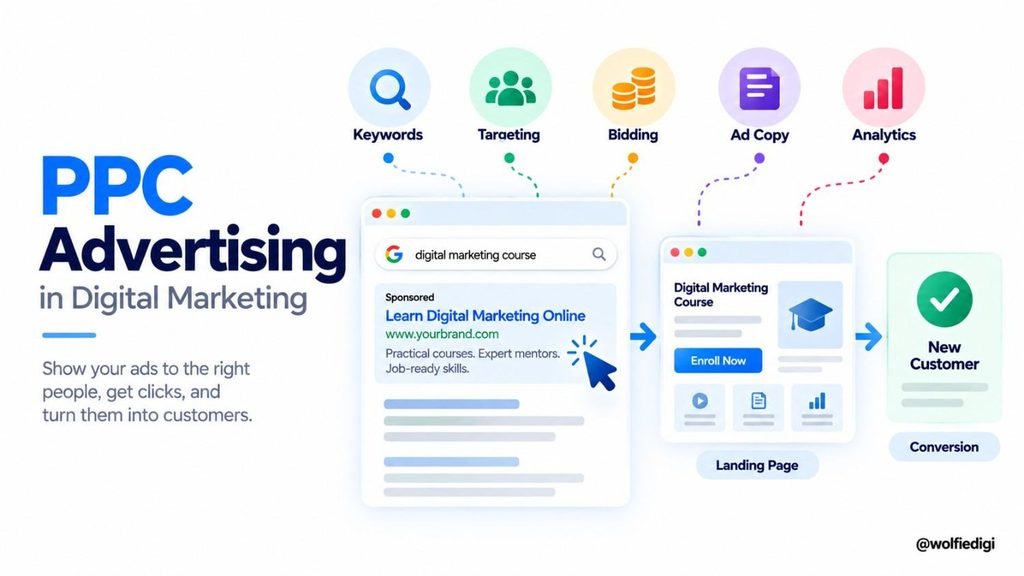
PPC advertising is a form of paid digital advertising where businesses pay when someone clicks on their ad. It is commonly used on search engines such as Google and Microsoft Bing, where advertisers can show ads to people actively searching for products, services, or information.
PPC can help businesses generate traffic, leads, sales, or other valuable actions without waiting for organic search visibility to develop. But successful PPC advertising involves more than paying for clicks. Advertisers need to choose the right keywords, create relevant ads, manage bids and budgets, and send visitors to useful landing pages.
What Is PPC Advertising in Digital Marketing?
PPC stands for pay-per-click. In digital marketing, PPC advertising refers to paid advertising campaigns where the advertiser is charged when someone clicks an ad, rather than simply when the ad is displayed.
A simple example is a company that sells running shoes. It could create a search ad targeting a query such as “buy running shoes online.” When the ad is eligible and a user clicks it, the advertiser may pay for that click.
PPC advertising is broader than one specific platform. Google Ads and Microsoft Advertising are two examples of platforms that support PPC campaigns.
PPC can be used across different advertising environments, including:
- Search engine results
- Shopping results
- Display advertising
- Some social advertising platforms
- Other websites and digital properties
However, paid search advertising is one of the most common forms of PPC and is particularly relevant when people are actively searching for something.
What Does Pay-Per-Click Advertising Mean?
The term “pay-per-click” describes the basic pricing model.
Pay means the advertiser spends money on advertising.
Per click means the advertiser is charged based on clicks under a CPC-based pricing model.
For example, suppose a business receives 100 clicks and its average cost per click is $1.50. Its advertising cost for those clicks would be approximately $150.
The actual cost can vary from one click to another, depending on the platform, auction, competition, targeting, bidding strategy, and other factors.
Importantly, PPC does not mean advertisers simply pay a fixed amount for a guaranteed position. On search platforms such as Google, ads enter auctions, and factors such as bid, ad quality, Ad Rank, search context, and other signals influence whether and where an ad appears.
What Is Paid Search Advertising?
Paid search advertising is advertising that appears on search engine results pages when advertisers target relevant searches.
For example, if someone searches for “digital marketing course,” a search engine may show paid advertisements from businesses offering related courses.
The advertiser typically selects keywords or uses other targeting signals, creates an ad, sets campaign parameters, and specifies where the visitor should go after clicking.
Paid search is different from organic search because the advertiser pays for advertising placement and traffic rather than earning the visit through unpaid search rankings.
This is also where PPC and SEO often work alongside each other. SEO can help a website earn organic visibility, while PPC can provide paid visibility for relevant searches.
How Does PPC Advertising Work?
PPC advertising usually follows a series of connected steps.
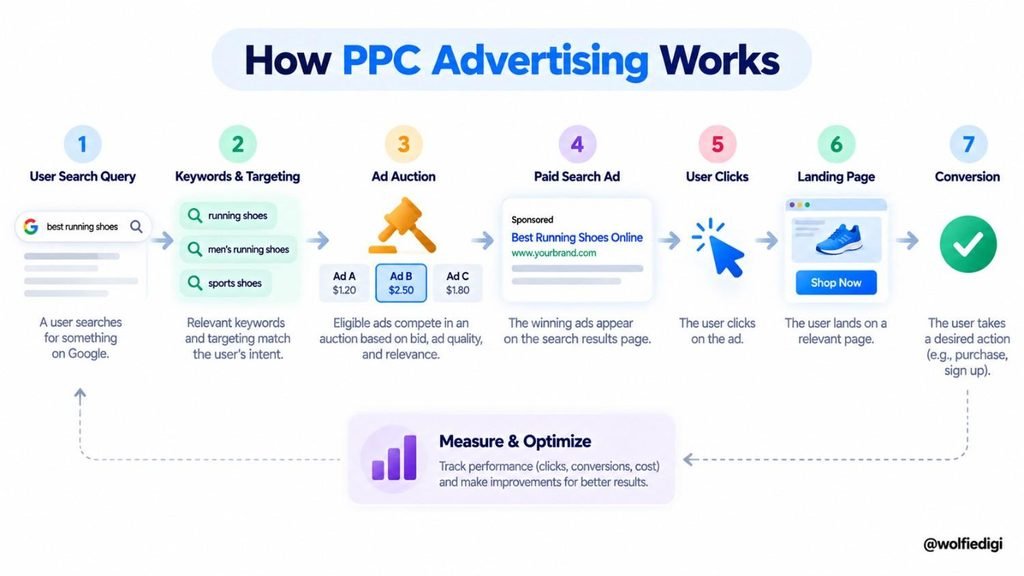
1. Choose a Campaign Goal
Before creating an advertisement, the business needs to decide what it wants the campaign to achieve.
Common goals include:
- Website traffic
- Leads
- Sales
- App activity
- Phone calls
- Brand awareness
The goal affects campaign settings, bidding, ad messaging, landing pages, and the metrics used to judge performance.
2. Identify Relevant Searches and Keywords
For search advertising, advertisers need to determine which searches are relevant to their products or services.
A company selling accounting software, for example, might target searches related to:
- Accounting software
- Small business accounting software
- Online accounting software
- Accounting software for freelancers
The goal is not simply to select keywords with high search volume. The keywords should also reflect the audience’s intent and be relevant to what the business offers.
3. Create the Ad
The advertiser then creates the advertising message.
For current Google Search campaigns, advertisers primarily use responsive search ads, where multiple headlines and descriptions can be supplied. Google Ads can combine these assets into different ad variations and use signals to determine relevant combinations for individual searches.
4. Enter the Ad Auction
When someone performs a relevant search, eligible ads can enter an auction.
Google explains that its ad auction determines whether an ad appears and where it appears. Ad Rank considers factors including the bid, ad quality, thresholds, search context, and the expected impact of ad assets and formats.
This means the advertiser with the highest bid does not automatically receive the highest position.
5. The User Clicks the Ad
If the advertisement appears and the user clicks it, the user is taken to the advertiser’s chosen destination, such as a landing page, product page, or website.
The advertiser may then be charged for that click under the campaign’s pricing model.
6. Measure the Result
The final step is measuring what happened after the click.
A click alone does not necessarily mean the campaign succeeded.
A business might instead care about whether the visitor:
- Submitted a form
- Bought a product
- Called the business
- Requested a quote
- Signed up for a service
- Downloaded something
That is why PPC campaigns need conversion tracking and meaningful performance measurement.
What Is a PPC Ad Campaign?
A PPC ad campaign is a structured set of paid advertisements and targeting settings created to achieve a particular marketing objective.
A campaign can contain settings such as:
- Campaign goal
- Budget
- Location targeting
- Audience targeting
- Bidding strategy
- Keywords or other targeting signals
- Ad groups
- Ads
- Landing pages
- Conversion tracking
For example, an online furniture store could create one campaign for office chairs and another for dining tables. Each campaign could then contain different ad groups, keywords, ads, and landing pages.
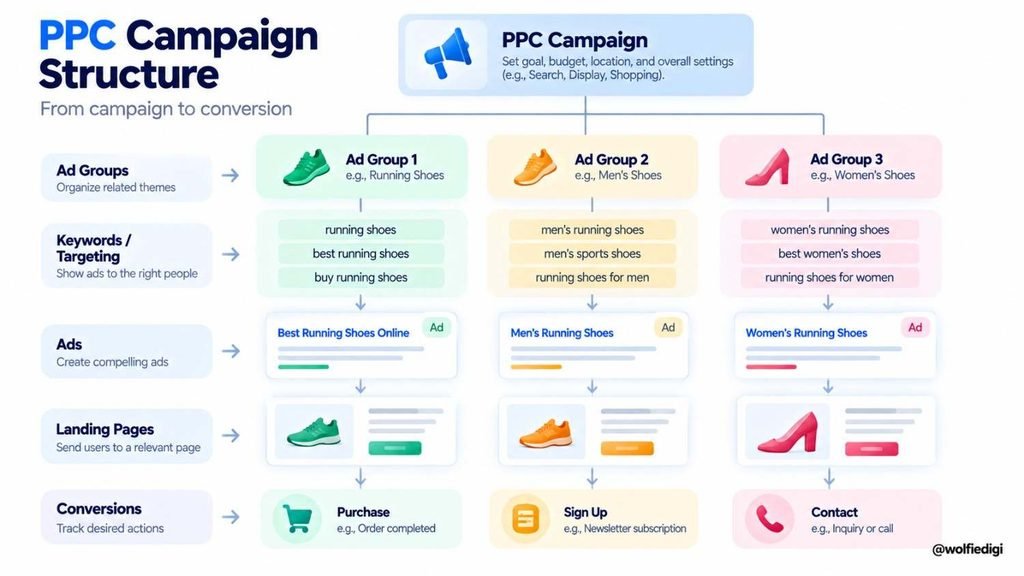
The exact campaign structure depends on the platform and advertising objective, but the underlying idea is the same: organize related targeting and advertisements around a specific goal.
What Is PPC Ad Copy?
PPC ad copy is the written messaging used in a paid advertisement.
For a search ad, this can include elements such as:
- Headlines
- Descriptions
- Calls to action
- Brand messaging
- Relevant keywords
- Product or service benefits
For example, an online accounting software company might use messaging such as:
Headline: Online Accounting Software
Headline: Simplify Small Business Finances
Description: Manage invoices, expenses, and reports in one place. Start today.
The purpose is not to fill the ad with as many keywords as possible. The copy should clearly communicate what the user gets by clicking.
Google’s current guidance recommends focusing ad messaging on user needs and benefits and making the copy relevant to the keywords and search context.
Responsive search ads also change how advertisers think about ad copy. Instead of creating one fixed combination of headlines and descriptions, advertisers provide multiple assets that the system can combine into different ads.
What Are the Main Components of a PPC Campaign?
A PPC campaign has several components that work together.
Campaign
The campaign provides the broader structure and settings, including objectives, budget, targeting, and bidding.
Ad Groups
Ad groups organize closely related targeting and advertisements.
For example, a shoe retailer might have separate ad groups for running shoes, hiking shoes, and walking shoes.
Keywords
Keywords help connect relevant searches with an advertiser’s campaign in search advertising.
The important consideration is search intent. A keyword should represent a search that is genuinely relevant to the product, service, or information being advertised.
Ads
Ads communicate the offer to potential customers.
The message should match the user’s search and clearly explain the value of visiting the destination page.
Landing Pages
The landing page is where the visitor arrives after clicking.
A relevant advertisement should lead to a page that continues the same message rather than sending the user to an unrelated homepage.
Budget and Bidding
The advertiser controls campaign spending through budget and bidding settings.
The exact controls depend on the advertising platform and campaign type.
Conversion Tracking
Conversion tracking helps determine whether clicks lead to valuable actions.
Without it, a campaign might appear to generate traffic while the advertiser has little understanding of whether that traffic is producing business results.
What Are the Benefits of PPC Advertising?
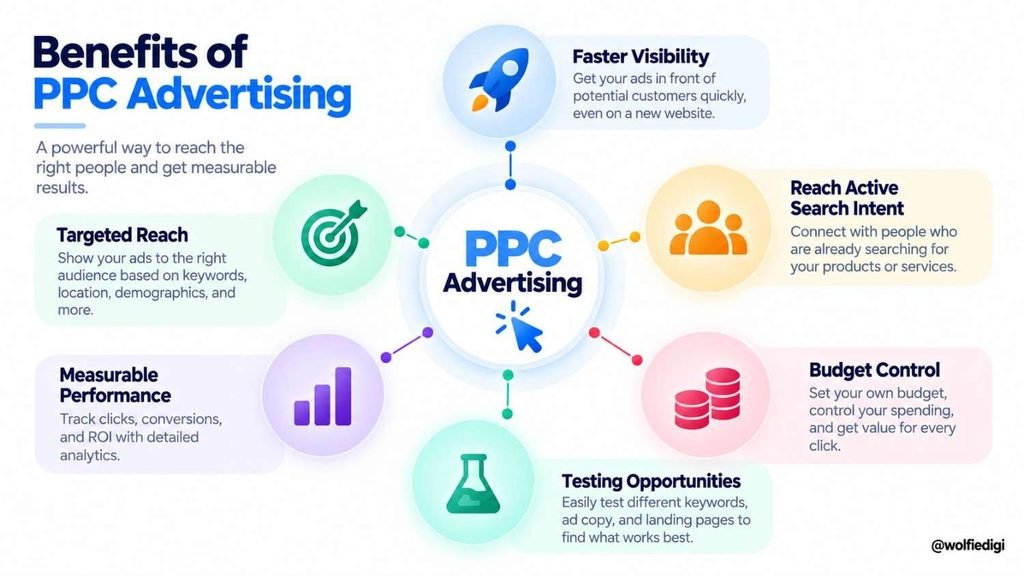
PPC advertising can provide several advantages when campaigns are properly targeted and measured.
Faster Visibility
SEO can take time to build organic visibility. PPC can allow eligible ads to appear in paid placements much sooner once campaigns are approved and running.
This makes PPC useful when a business needs to promote a new product, service, offer, or landing page.
Reaches People With Active Intent
Paid search can put an advertisement in front of someone who is already searching for a relevant product, service, or solution.
For example, a person searching for “emergency plumber near me” has a different level of intent from someone casually reading an article about plumbing.
Targeted Advertising
PPC platforms provide various targeting and campaign controls.
Depending on the platform and campaign type, advertisers can target factors such as location, language, audience characteristics, devices, search queries, and other signals.
Measurable Performance
PPC campaigns generate detailed performance data.
Advertisers can examine metrics such as:
- Impressions
- Clicks
- Cost
- Click-through rate
- Conversions
- Cost per conversion
- Conversion value
- Return on ad spend
This makes it possible to connect advertising spend with measurable outcomes when conversion tracking is configured correctly.
Budget Control
Advertisers can set campaign budgets and bidding parameters to control how much they are willing to spend.
For example, Microsoft Advertising allows advertisers to set daily or monthly campaign budgets and define maximum amounts they are willing to pay for clicks, impressions, or conversions, depending on the campaign setup.
Budget control does not guarantee a particular number of clicks or conversions, but it helps advertisers manage expenditure.
Useful for Testing
PPC can also be used to test messaging, offers, keywords, and landing pages.
If a business wants to learn which value proposition attracts more qualified visitors, it can test different ad messages and examine the resulting performance.
What Are the Limitations of PPC Advertising?
PPC is not a guaranteed shortcut to profitable marketing.
It Costs Money
Unlike organic traffic, PPC traffic requires advertising spend.
If a business stops its campaigns, the paid traffic generated by those campaigns generally stops as well.
Competition Can Increase Costs
Popular keywords and audiences can have significant competition.
When advertisers compete for the same opportunities, costs and performance can change.
Clicks Do Not Guarantee Conversions
A person can click an advertisement without buying anything or becoming a lead.
That means the campaign needs more than attractive ads. The landing page, offer, targeting, and overall customer experience also matter.
Poor Targeting Can Waste Budget
If advertisements reach people who are unlikely to become customers, the campaign can spend money without producing useful results.
This is why keyword selection, audience targeting, negative keywords where applicable, and ongoing campaign analysis matter.
Campaigns Need Ongoing Management
PPC is not always a set-it-and-forget-it channel.
Search behavior, competition, costs, conversion rates, and business priorities can change. Campaigns often require monitoring and optimization.
PPC vs Organic Search
PPC and SEO both help businesses appear in search results, but they do so through different mechanisms.
With PPC, the business pays for advertising opportunities and can use campaign settings to target relevant searches and audiences.
With SEO, the business works to improve its website’s organic visibility through factors such as useful content, technical accessibility, site structure, and relevance.
They can complement each other.
For example, PPC can help a business generate visibility for commercially important searches while its SEO strategy works toward longer-term organic visibility.
This is particularly useful when the business wants to understand search behavior while also building its organic presence.
How Does PPC Fit Into Digital Marketing?
PPC is one part of a broader digital marketing strategy.
A business might use:
- SEO for organic search visibility
- Content marketing for education and demand creation
- Social media marketing for engagement and distribution
- Email marketing for ongoing communication
- PPC for paid traffic and targeted promotion
- Analytics for measuring performance across channels
For example, a business could publish an educational article, promote it through social media, capture interested visitors through email, and use PPC to reach people searching for high-intent commercial terms.
WolfieDigi treats these channels as connected parts of digital marketing rather than isolated tactics, which is important when building a broader understanding of how online marketing works.
What Should a Good PPC Ad Include?
A good PPC ad should quickly communicate why the user should pay attention.
Depending on the campaign, the message may include:
- A clear connection to the search
- A useful benefit
- A relevant product or service
- A reason to choose the business
- A clear call to action
- Accurate expectations about the landing page
For example, instead of writing:
Best Solutions for Everyone — Click Now!
A more specific message might be:
Affordable Accounting Software for Small Businesses
Manage invoices, expenses, and reports online. Start your free trial.
The second example tells the user what the product is, who it is for, and what action they can take.
Google’s current guidance similarly recommends specific, genuine messaging focused on user needs and benefits rather than generic claims.
What Makes a PPC Campaign Effective?
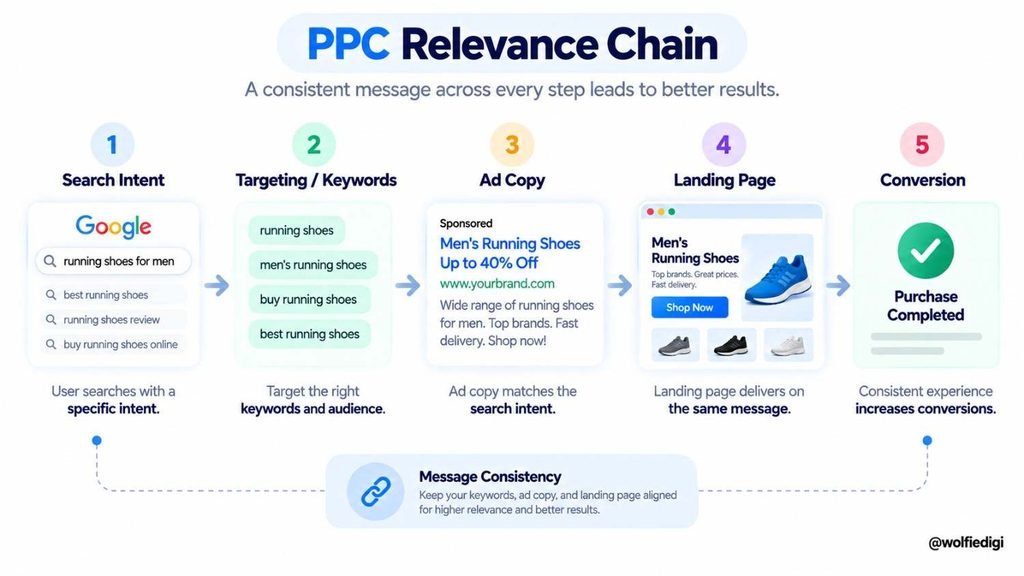
A PPC campaign works best when its different components support the same user intent.
The keyword or targeting should match the advertisement. The advertisement should match the landing page. The landing page should then make it easy for the visitor to complete the intended action.
Think of it as a chain:
Search intent → Targeting → Ad → Landing page → Conversion
If one part is poorly aligned, the campaign can lose efficiency.
For example, an advertisement for “running shoes for beginners” that sends visitors to a generic clothing homepage creates unnecessary friction. A relevant landing page showing suitable running shoes would provide a more consistent experience.
Final Thoughts
PPC advertising in digital marketing is a paid advertising approach where businesses pay for clicks or other measurable actions depending on the campaign and platform. It is commonly used to reach people through search engines and other digital advertising environments.
A PPC campaign involves much more than choosing a budget and writing an advertisement. Advertisers need to understand search intent, choose relevant targeting, create useful ad copy, manage bids and budgets, connect ads with relevant landing pages, and measure conversions.
The biggest advantage of PPC is the ability to reach relevant audiences through paid visibility and measure what happens after people interact with the ads. But getting clicks is only one part of the process. The real goal is to turn relevant traffic into meaningful business results.