
When you type something into Google and get relevant results within seconds, the search engine is not searching the entire live web from scratch. It is searching a massive, continuously updated index of information that its systems have already discovered, processed, and stored.
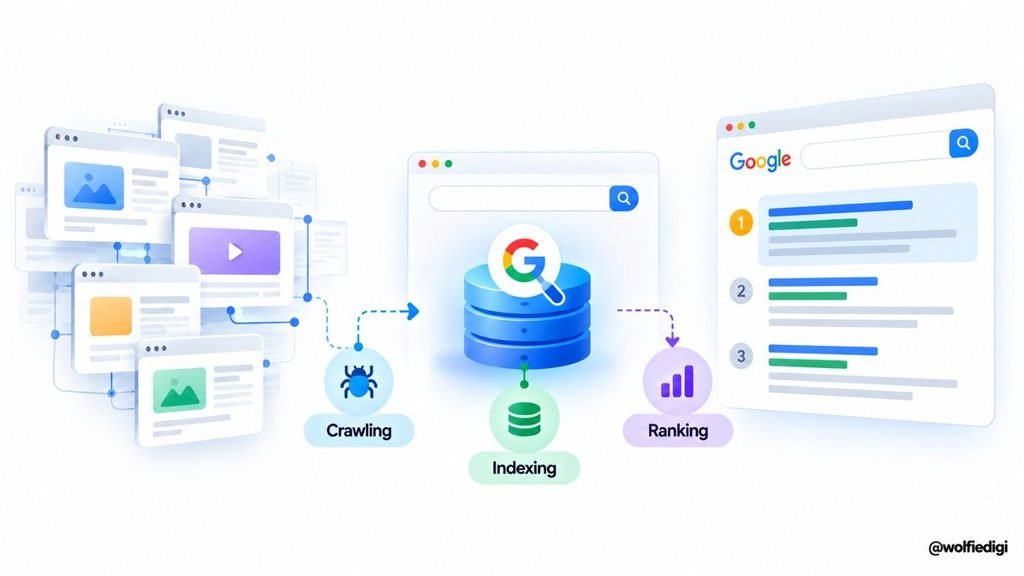
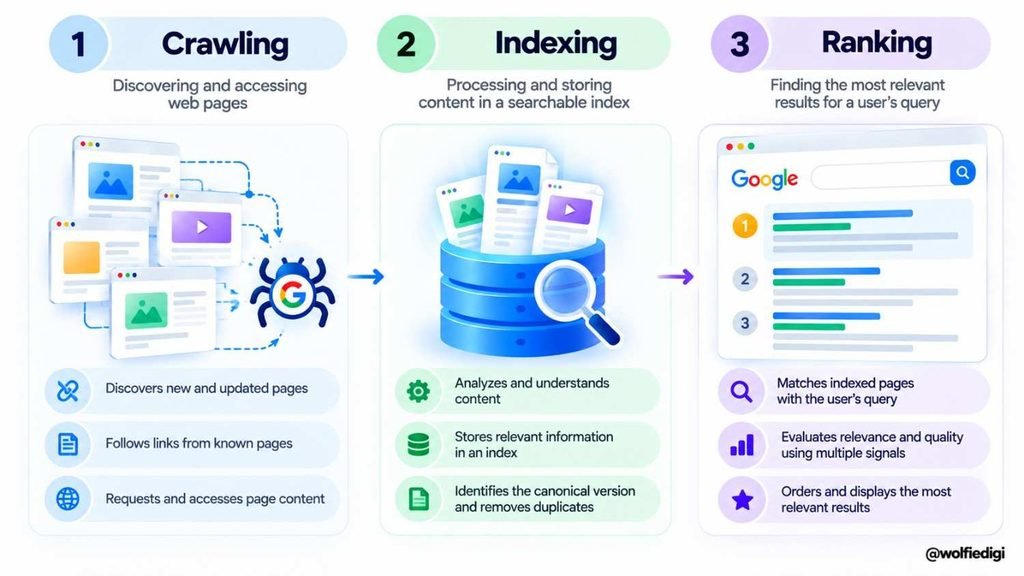
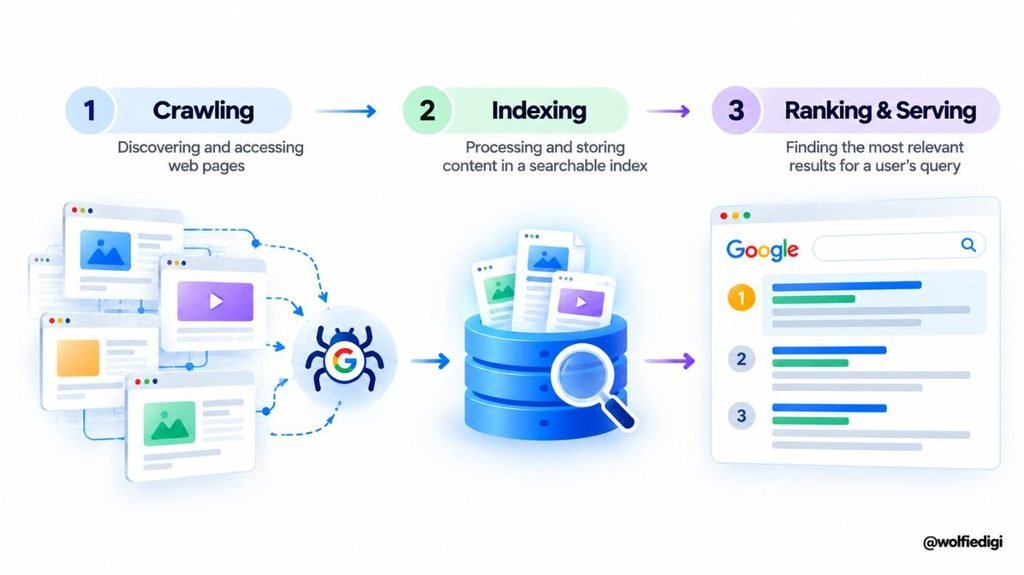
At a high level, search engines work through three major stages: crawling, indexing, and serving search results. Crawling discovers and fetches pages, indexing processes and stores information about them, and serving uses the search engine’s systems to find and order relevant results when someone searches.
Understanding this process is one of the foundations of SEO. It explains why a page can be published but not indexed, indexed but not rank well, or technically accessible but still fail to appear for a particular search.
What Is a Search Engine and How Does It Work?
A search engine is a system that helps people find information on the internet by discovering web content, organizing it in an index, and returning relevant results for a search query.
Google, Bing, and other search engines use automated programs called web crawlers to discover pages. They then process the information they find and store useful information in large search indexes.
When you perform a search, the search engine does not normally crawl every website at that exact moment. Instead, it uses its existing index to identify pages that may be relevant to your query and then determines which results to show.
The simplified process looks like this:
Web pages → Crawling → Processing & indexing → Search query → Retrieval & ranking → Search results
That entire system operates at enormous scale.
How Do Search Engines Work Step by Step?
The simplest way to understand how search engines work is to follow a webpage from publication to the search results page.
Step 1: A Webpage Is Published
Suppose you publish a new article about email marketing.
The page now exists on your website, but that does not automatically mean a search engine knows about it or has added it to its index.
The search engine first needs to discover the URL.
Step 2: The Search Engine Discovers the URL
Search engines can discover URLs through several sources.
One of the most important is links.
If an existing page links to your new article, a crawler can follow that link and discover the new URL. Search engines can also discover URLs through XML sitemaps and previously known URLs. Google explains that there is no central registry of every webpage, so its systems continually discover new and updated URLs across the web.
This is one reason internal linking matters for SEO. A well-connected website makes it easier for search engines to discover important pages.
Step 3: The Crawler Fetches the Page
Once the URL is known, a search engine crawler may request the page from the server.
For Google Search, the main crawler is Googlebot.
The crawler retrieves resources that are available to it and processes the page. Depending on the page, this can involve fetching HTML, images, CSS, JavaScript, and other resources.
Access can be affected by technical problems, server errors, network issues, or crawling rules such as robots.txt.
What Is Crawling in Search Engines?
Crawling is the process search engines use to discover and fetch webpages and other accessible resources.
A crawler is an automated program that moves through the web by discovering URLs and requesting content from them.
A simplified example looks like this:
Known page → Link to new page → Crawler discovers URL → Crawler fetches page → More links are discovered
This process continues across an enormous network of websites.
Do Search Engines Crawl Every Page?
No.
Search engines do not guarantee that every discovered URL will be crawled, indexed, or shown in search results.
Crawling also has practical limits. Google uses crawl capacity systems to avoid putting unnecessary load on websites while still attempting to discover and refresh important content.
For a small website, this usually does not mean you need to obsess over crawl budget. More important fundamentals are making important pages accessible, using crawlable links, avoiding unnecessary technical barriers, and maintaining a sensible site structure.
What Does a Sitemap Do?
A sitemap gives search engines information about URLs that you consider important.
It can help search engines discover pages, particularly on larger or more complex websites.
However, a sitemap is not a guarantee of crawling or indexing. Google describes sitemaps as a way to help it discover URLs more efficiently, not as an instruction that every submitted URL must be indexed.
What Happens During Indexing?
Crawling and indexing are not the same thing.
After a search engine fetches a page, it needs to process and understand the information before deciding whether and how to store it in its index.
This stage is called indexing.
Google says its indexing process analyzes content such as text, images, videos, titles, and other important page information. It also considers whether a page is a duplicate and which version should be treated as canonical.
Rendering the Page
Modern websites often rely on JavaScript.
A crawler may therefore need to render the page so that the search engine can understand content that isn’t immediately available in the initial HTML.
Google explains that its crawler can render pages and execute JavaScript using a recent version of Chrome.
This matters because what a user sees in a browser and what a crawler receives in the initial response are not always identical.
Understanding the Content
The search engine analyzes what the page contains and what it appears to be about.
This can involve information such as:
- Main text
- Page title
- Images
- Alt attributes
- Links
- Structured data
- Other page metadata
The goal is to understand the content well enough to determine how it can be used in Search.
Handling Duplicate Pages
Search engines can encounter multiple URLs containing the same or very similar content.
For example:
example.com/article
and
example.com/article?sort=new
might potentially lead to versions of closely related content.
Google uses canonicalization to select a representative URL from duplicate or very similar pages. A canonical URL is Google’s chosen representative version of that content.
A website can provide canonical signals, but Google may choose a different canonical URL if its systems determine that another version is more appropriate.
Not Every Crawled Page Gets Indexed
This is an important distinction.
Crawled ≠ indexed.
A search engine can successfully access a page and still decide not to include it in its searchable index.
Possible reasons include technical restrictions, duplicate content, quality considerations, or other indexing decisions. Google explicitly states that not all pages make it through each stage of Search.
What Is Search Engine Ranking?
Once a page is available in the search index, the search engine needs to determine whether it is relevant to a particular query and where it should appear.
This is the ranking part of the process.
Suppose someone searches:
“how does email marketing work?”
There could be thousands or millions of pages containing information related to email marketing.
The search engine needs to identify the pages that best match the query and determine how the results should be ordered.
Google describes its serving process as using its index to return information it considers relevant and high quality for the user’s query. It uses hundreds of factors, and the results can vary based on factors such as the query, language, location, and device.
What Factors Affect Search Engine Ranking?
There is no single ranking factor that determines where every page appears.
Search engines use many signals and systems to evaluate relevance and quality.
Depending on the query, these can involve factors related to:
- Relevance to the search query
- Content quality and usefulness
- The meaning and intent of the query
- The quality and context of links
- Freshness where freshness matters
- Location and language
- Page experience
- Other search-specific signals
The relative importance of these signals can change depending on the search.
For example, a search for:
“weather today”
requires very different information from:
“history of digital marketing”
Freshness and location are much more important for the first query.
This is why there is no universal checklist that guarantees a first-place ranking.
Does Page Experience Affect Ranking?
Page experience is one part of Google’s broader ranking systems.
Google says its systems consider multiple aspects of page experience, including Core Web Vitals, secure delivery, mobile usability, and avoiding intrusive elements. However, Google also makes clear that having excellent page-experience scores does not guarantee top rankings.
The larger principle is simple: make pages useful and usable for people, rather than optimizing one isolated metric.
How Do Search Engines Work So Fast?
This is one of the most interesting parts of search.
If search engines had to crawl the entire web every time someone typed a query, search would be far too slow.
Instead, much of the expensive work happens before the search takes place.
Search engines continuously crawl webpages, process information, build indexes, and organize data in ways that allow queries to be answered efficiently.
When you enter a search, the system can then work primarily with its existing index rather than starting from zero.
A simplified comparison is:
Slow approach:
Search query → crawl the entire web → analyze every page → rank everything → show results
Real-world approach:
Web crawling & processing happen continuously → search index is maintained → user searches → relevant candidates are retrieved → results are ranked → results are served
This pre-processing is a major reason search can return results so quickly.
The exact infrastructure behind modern search engines is extremely complex, but the basic idea is easier to understand: search engines do much of the work before you ever type your query.
What Happens When You Type a Search Query?
Now consider what happens when someone actually searches.
Suppose the query is:
“what is crawling in SEO?”
The process can be simplified into several steps.
1. The Search Engine Interprets the Query
The system needs to understand what the user is asking.
It may consider the words used, their meaning, the likely intent, and contextual information.
2. It Finds Relevant Information in the Index
The search engine searches its index for pages and information that could answer the query.
It is not simply looking for pages containing the exact phrase.
Modern search systems can understand relationships between words, concepts, entities, and meanings.
3. Candidate Results Are Evaluated
Potential results are evaluated using the search engine’s ranking systems.
Relevance, quality, context, and other signals help determine which pages are appropriate for the query.
4. Results Are Ordered and Served
The system determines which results and search features should appear and presents them to the user.
Depending on the query, the page might contain traditional web results alongside images, videos, local results, news, or other search features.
Google notes that the search features shown can change depending on the query.
Crawling vs Indexing vs Ranking: What’s the Difference?
These three concepts are related, but they are not interchangeable.
| Process | What it means | Simple question |
|---|---|---|
| Crawling | Discovering and fetching a webpage | Can the search engine find and access it? |
| Indexing | Processing and storing information about the page | Does the search engine understand and store it? |
| Ranking | Selecting and ordering relevant results | Where should it appear for this query? |
A useful way to remember it is:
Crawling = Find it
Indexing = Understand and store it
Ranking = Decide where it belongs for a search
A page can pass one stage and fail at another.
For example, your article might be crawled but not indexed. Or it might be indexed but appear very low for the searches you care about.
Can a Page Be Indexed but Not Rank?
Yes.
Being indexed does not mean a page will rank highly.
Indexing simply means the search engine has processed and stored the page in its index and considers it eligible for Search under its systems.
When a user searches, the page still needs to compete with other relevant pages.
Google specifically notes that a page can be reported as indexed in Search Console but still not appear for a particular search because of factors such as relevance, quality, or serving restrictions.
This distinction is important for SEO.
If a page is not indexed, improving its rankings may not be the immediate problem.
If it is indexed but receives little visibility, the issue may instead involve relevance, content quality, competition, search intent, or other ranking considerations.
How Do Search Engines Handle AI Search?
Search is no longer limited to the traditional results page.
Google now has AI features such as AI Overviews and AI Mode, which can provide synthesized responses and links to supporting webpages.
However, these experiences do not make crawling and indexing irrelevant.
Google explains that its AI search features are built on its existing Search and ranking systems. AI features can retrieve relevant information from the Search index and use techniques such as query fan-out to explore related searches and sources.
That means the fundamental SEO foundation remains important:
Crawlable content → Indexed content → Search relevance → Potential visibility in traditional and AI search experiences
Google also says there are no special AI-only technical requirements or special markup required for a site to appear in AI Overviews or AI Mode. Foundational SEO practices remain the basis.
This is important because terms such as AEO and GEO are increasingly used in the industry. Google itself says that, from its perspective, optimizing for generative AI search is still part of optimizing for the overall search experience rather than a completely separate replacement for SEO.
What Does This Mean for SEO?
Understanding how search engines work changes how you approach SEO.
SEO is not simply:
“Put a keyword on a page and wait for Google.”
A page first needs to be discoverable and accessible.
Then its content needs to be understandable and eligible for indexing.
Finally, when someone searches, the page needs to be relevant and useful enough to compete with other results.
This is why technical SEO, content quality, search intent, internal linking, and other SEO practices work together rather than functioning as isolated tricks.
For example, a page with excellent content can still have problems if search engines cannot access it. Likewise, a technically perfect page may not rank well if it does not provide a useful answer to the searcher’s question.
If you are learning the broader subject, our guide to SEO and why it matters explains how these search-engine processes connect to the wider practice of SEO.
And if you want to understand what happens after search data is collected, our guide to digital marketing analytics covers how marketers use data to evaluate performance and make decisions.
Common Misunderstandings About How Search Engines Work
“Google searches the entire internet every time I search.”
Not exactly.
Google searches its existing index and uses its systems to retrieve and rank relevant information.
“If Google crawls my page, it will definitely index it.”
No.
Crawling and indexing are separate stages.
“If my page is indexed, it will rank.”
Not necessarily.
Indexed pages still compete for visibility based on relevance, quality, and other ranking systems.
“A sitemap guarantees indexing.”
No.
A sitemap can help search engines discover URLs, but it does not guarantee that those URLs will be crawled or indexed.
“There is one ranking factor that determines everything.”
No.
Search engines use many signals and systems, and their importance can vary by query.
“AI search has replaced traditional SEO.”
No.
AI search is changing how search results can be presented and how users interact with Search, but the underlying need for crawlable, indexable, useful content remains.
How Can You Help Search Engines Discover and Understand Your Website?
You do not need to control the search engine itself.
You can make your website easier for search engines to discover and process.
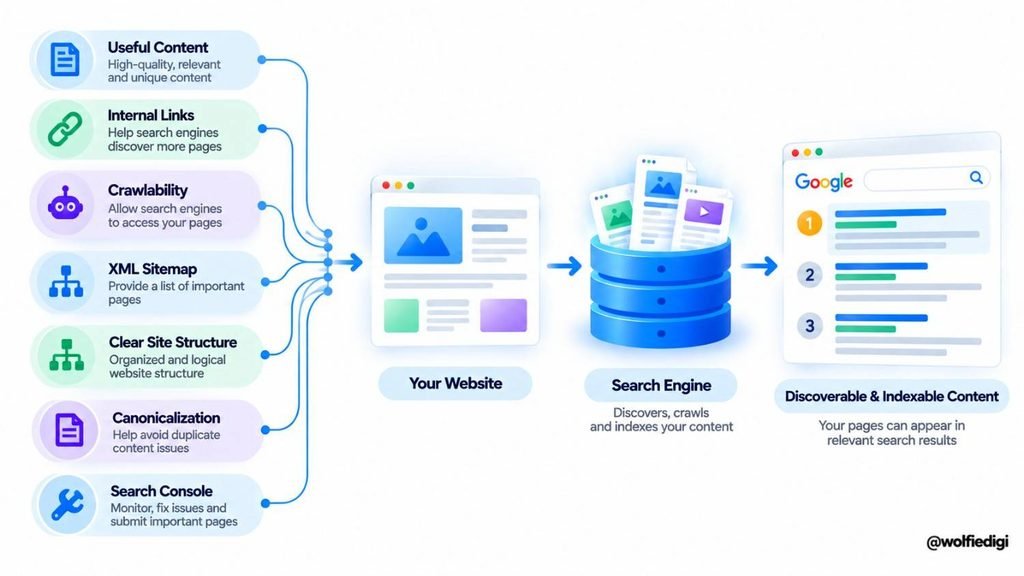
Some fundamentals include:
- Create useful, original content.
- Build clear internal links between related pages.
- Keep important pages accessible to crawlers.
- Use crawlable links.
- Maintain a sensible site structure.
- Provide an XML sitemap when appropriate.
- Avoid accidentally blocking important pages.
- Use canonicalization appropriately for duplicate or similar URLs.
- Make important content available in text.
- Monitor indexing and technical issues in Google Search Console.
Google’s current documentation continues to emphasize crawlability, internal linking, useful content, and clear technical structure as foundational SEO practices, including for its newer AI search experiences.
For a growing knowledge site like WolfieDigi, this also explains why a connected internal-link structure matters: each useful article can help search engines discover related content while giving readers a clear path through the site’s knowledge base.
Final Thoughts
Search engines may look simple from the outside: type a question, receive results.
Behind that simple interface is a large system that continuously discovers webpages, fetches and renders content, processes and indexes information, and then retrieves and ranks relevant results when someone searches.
The easiest mental model is:
Crawling → Indexing → Ranking/Serving
But the real process has more steps underneath those three labels. URLs have to be discovered, pages have to be accessible, content may need to be rendered, duplicate versions may need to be consolidated, and the search engine must interpret the user’s query before deciding what information to show.
For SEO, this gives you a much more useful starting point than memorizing ranking factors. Before asking why a page is not ranking, ask a simpler question: Can the search engine discover it, access it, understand it, index it, and determine that it is relevant to the search?