
Social media marketing has become more than simply posting content on Facebook, Instagram, LinkedIn, YouTube, or other platforms. Businesses can use social media to reach specific audiences, publish different types of content, communicate directly with customers, build communities, run paid campaigns, and measure what happens after people interact with their content.
The most important features of social media marketing come from this combination of reach, interaction, targeting, content, measurement, and flexibility. Understanding these features gives you a clearer idea of what social media marketing actually involves and why businesses use it.
What Is Social Media Marketing?
Social media marketing is the use of social media platforms to promote a business, build relationships with an audience, distribute content, and achieve marketing goals such as awareness, traffic, leads, sales, or customer retention.
It can include both organic activities, such as regular posts and community engagement, and paid activities, such as social media advertising.
Unlike traditional one-way advertising, social media allows businesses to communicate with people directly. Customers can comment, share, message, react, ask questions, and sometimes create content around a brand themselves.
For example, a clothing brand might use Instagram to publish styling videos, respond to customer questions in comments and DMs, collaborate with creators, promote products through paid ads, and measure which posts generate the most engagement or website visits.
That combination of publishing, interaction, distribution, and measurement is what makes social media marketing different from simply maintaining a social media account.
Social media marketing is closely connected to other digital marketing channels, especially content marketing, because businesses often use social platforms to distribute, promote, and repurpose the content they create. If you want to understand how that broader approach works, see our guide to what content marketing is and how it works.
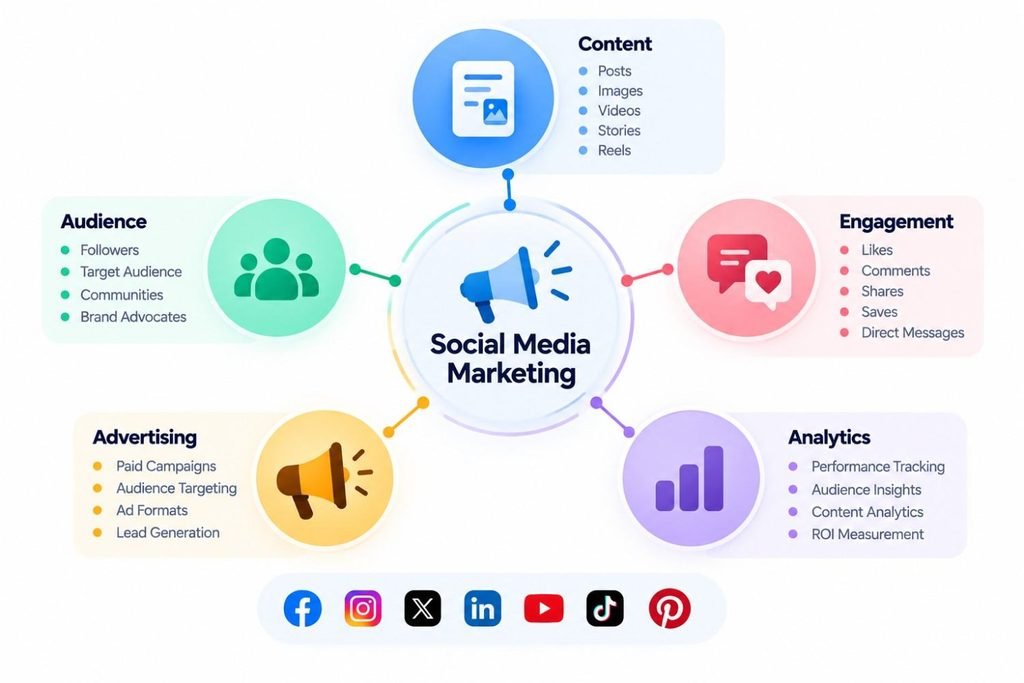
What Are the Main Features of Social Media Marketing?
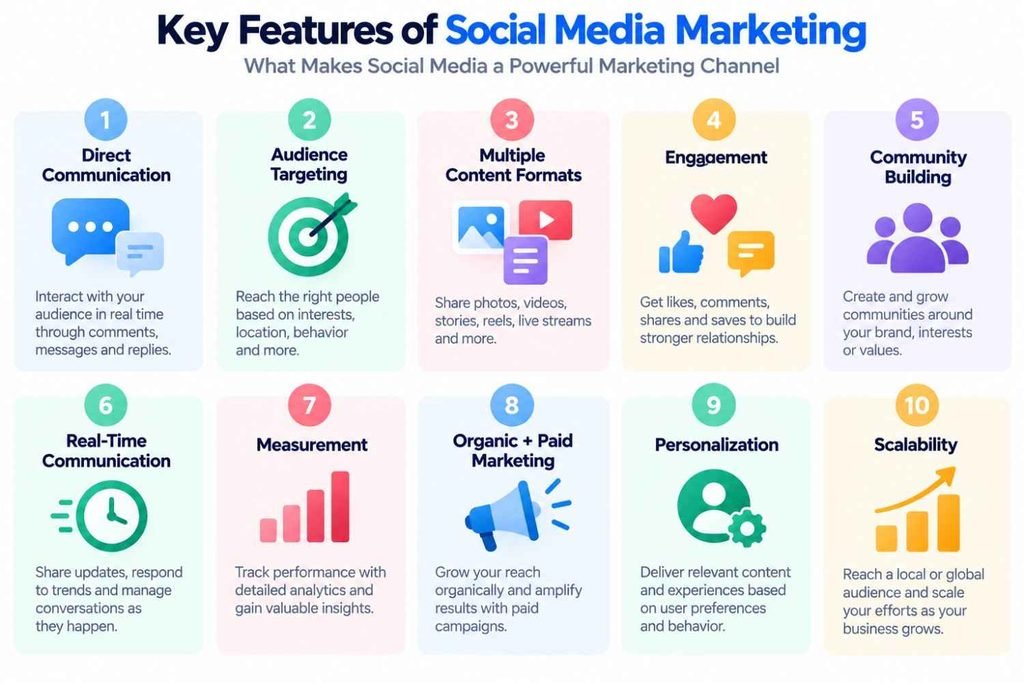
Social media marketing has several features that make it different from traditional marketing channels. It allows businesses to reach specific audiences, publish different types of content, interact directly with people, build communities, and measure how their efforts perform.
1. Direct Communication With the Audience
One of the defining features of social media marketing is that communication can happen in both directions.
A business can publish a message, but the audience can respond immediately through comments, messages, reactions, shares, or other interactions.
For example, a restaurant could post a new menu item and receive questions about ingredients, prices, or availability directly from customers.
This gives businesses an opportunity to understand what people are asking and respond in the same environment.
2. Audience Targeting
Social platforms can help marketers reach specific groups instead of showing every message to everyone.
Depending on the platform and activity, marketers can work with factors such as interests, location, demographics, behavior, existing audiences, or interactions with previous content.
This is particularly important for paid social advertising, where targeting can determine who is eligible to see an advertisement.
The practical advantage is simple: a business selling professional accounting software does not necessarily need to reach every social media user. It needs to reach people who are more likely to have a relevant business need.
3. Multiple Content Formats
Social media supports many different content formats.
Depending on the platform, these can include:
- Short-form videos
- Long-form videos
- Images
- Carousels
- Stories
- Live streams
- Text posts
- Polls
- Links
- User-generated content
- Direct messages
Different formats can serve different purposes.
A short video may help attract new viewers, while a carousel could explain a process and a live session could allow a business to answer questions in real time.
The important point is not to use every available format simply because it exists. The format should fit the audience, message, and objective.
4. Two-Way Engagement
Social media is designed around interaction.
People can comment on posts, share content, send messages, participate in discussions, mention brands, and react to what they see.
For marketers, engagement is more than a vanity metric. It can provide signals about what interests an audience and reveal questions or objections that may need to be addressed.
A business that consistently responds to useful comments and questions can also make its social presence feel more like a conversation than a broadcast.
5. Community Building
Social media can help businesses build communities around shared interests, problems, products, or values.
For example, a fitness brand might create content around running and encourage followers to share their progress. A software company might build a community where users exchange tips and ask questions.
Community building is different from simply accumulating followers. A large follower count does not automatically mean that people are actively interested in or connected to a brand.
6. Real-Time Communication
Social platforms allow businesses to respond quickly to events, customer questions, trends, product announcements, and conversations.
This can be useful when timing matters.
For example, a company can respond to a product question shortly after someone posts it instead of waiting for a formal customer-service interaction.
Real-time communication can also create risks. Posting too quickly without checking facts or considering context can damage credibility, so speed should not replace judgment.
7. Measurable Performance
Another major feature of social media marketing is the amount of performance data available to marketers.
Depending on the platform, businesses can measure things such as:
- Reach
- Impressions
- Views
- Engagement
- Clicks
- Follower growth
- Website activity
- Leads
- Conversions
- Audience characteristics
For example, YouTube Analytics provides reports covering reach, engagement, audience, content performance, and revenue, while its Trends information can help creators identify topics and content gaps.
This allows marketers to compare results and adjust their strategy instead of relying entirely on assumptions.
8. Organic and Paid Marketing
Social media marketing can combine organic and paid distribution.
Organic activity includes things such as regular posts, comments, community participation, and unpaid content distribution.
Paid social involves paying platforms to distribute advertisements to selected audiences.
The two approaches can complement each other. For example, a business might publish educational content organically and use paid advertising to reach a larger or more specific audience with a particular offer.
9. Personalization
Social media can make communication more relevant to different audiences.
A brand may create different content for beginners and experienced customers, use different messages for different customer groups, or personalize communication through direct interactions.
Personalization is particularly useful when a business serves audiences with different needs.
However, personalization should be based on useful audience understanding rather than simply inserting someone’s name into a message.
10. Flexible and Scalable Marketing
Social media can be used by a small local business as well as a large international company.
A local bakery might use Instagram to show products and communicate with nearby customers. A software company might use LinkedIn, YouTube, and paid campaigns to reach businesses across several countries.
The scale can change without changing the basic principles: understand the audience, create useful content, distribute it effectively, engage with people, and measure the results.
Why Do These Features Matter?
The individual features become more useful when they work together.
Imagine a small skincare brand.
It could use:
Audience targeting to identify the people most interested in skincare.
Content formats to create tutorials, product demonstrations, and short videos.
Engagement to answer questions about products.
Community building to encourage customers to share their experiences.
Paid advertising to reach new potential customers.
Analytics to identify which content and campaigns are producing useful results.
The value is not in any single feature. The value comes from connecting them into a coherent marketing system.
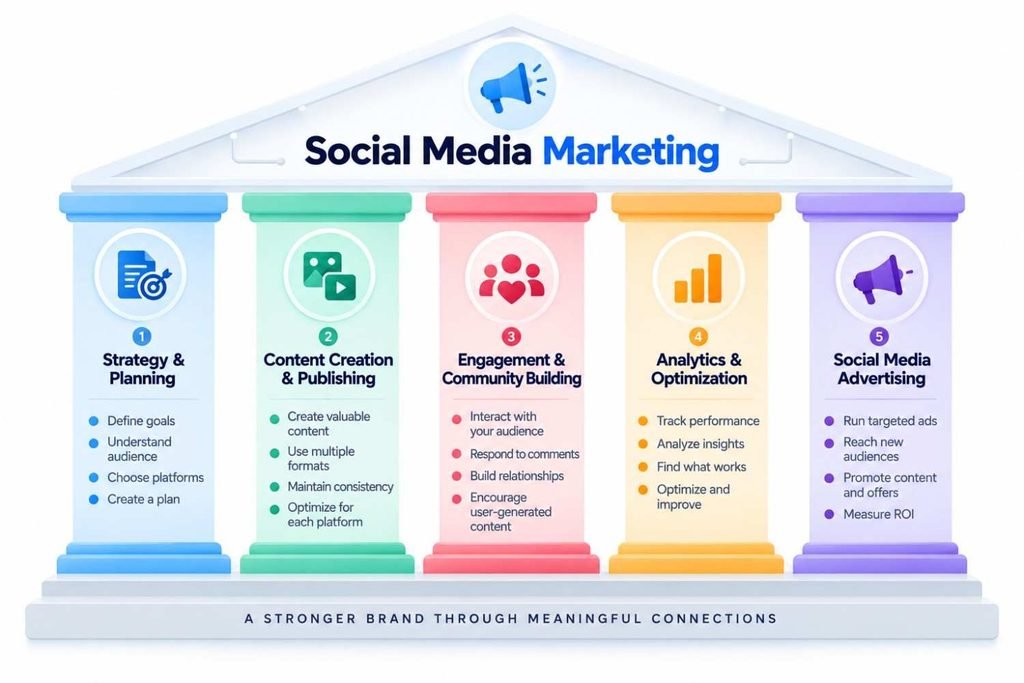
What Are the 5 Pillars of Social Media Marketing?
There is no single universally accepted version of the five pillars of social media marketing. Different educational and marketing sources group the activities slightly differently.
A common framework uses these five areas:
- Strategy and planning
- Content creation and publishing
- Engagement and community building
- Analytics and optimization
- Social media advertising
Current sources use very similar frameworks, although the names and grouping of individual activities can differ.
1. Strategy and Planning
This is the foundation.
Before creating posts, decide:
- Who is the target audience?
- What are the marketing goals?
- Which platforms are relevant?
- What type of content should be created?
- What metrics will determine success?
Without this step, social media can become a collection of unrelated posts.
2. Content Creation and Publishing
The second pillar is producing and publishing content that fits the audience and goals.
This could include educational posts, videos, product demonstrations, customer stories, entertainment, or other useful formats.
A content calendar can help organize topics, formats, campaigns, and publishing dates.
3. Engagement and Community Building
Publishing is only one side of social media.
Marketers also need to monitor comments, answer questions, participate in relevant conversations, and develop relationships with their audience.
This is where social media becomes genuinely social.
4. Analytics and Optimization
Analytics helps marketers understand what is working and what needs to change.
For example, if one type of video consistently attracts more relevant viewers but another gets many views without meaningful engagement, the data can help inform future decisions.
Optimization means using those observations to improve future content and campaigns.
5. Social Media Advertising
Paid advertising allows businesses to extend their reach beyond organic distribution.
Ads can be used for objectives such as awareness, website traffic, lead generation, app promotion, or sales.
Platforms also provide measurement and targeting tools. For example, Meta describes Reels advertising as offering targeting and measurement capabilities through its advertising system.
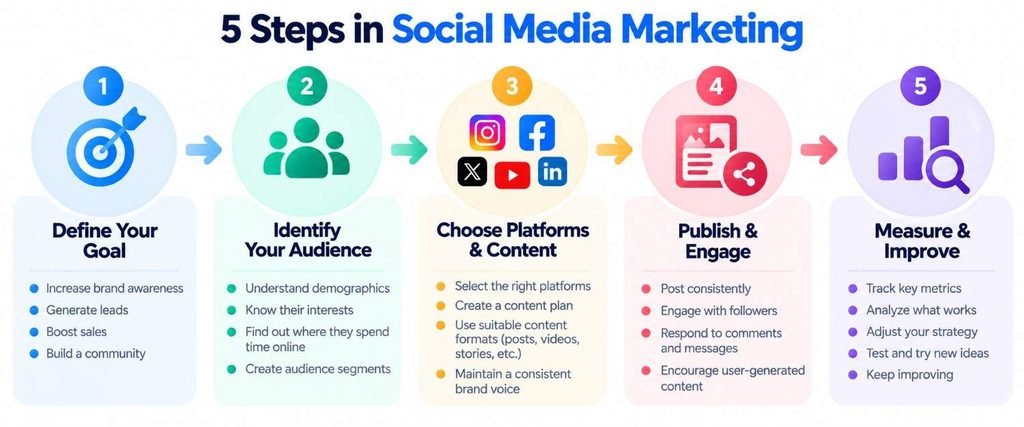
What Are the 5 Steps in Social Media Marketing?
The exact number of steps varies between frameworks, but beginners can understand the process through five practical stages:
1. Define Your Goal
Decide what you want social media to achieve.
Examples include:
- Increase brand awareness
- Generate website traffic
- Get leads
- Increase sales
- Build a community
- Improve customer relationships
A clear goal makes it easier to decide what content and metrics matter.
2. Identify Your Audience
Understand who you want to reach.
Look at their:
- Problems
- Interests
- Questions
- Preferred platforms
- Content preferences
- Buying behavior
The goal is not to create content for “everyone.”
3. Choose Platforms and Content
Select the platforms where your target audience is relevant.
Then choose content formats that suit both the platform and your audience.
A business does not need to maintain an active presence on every social network.
4. Publish and Engage
Create and publish useful content consistently.
Then monitor comments, messages, discussions, and audience reactions.
Social media marketing is not finished when a post is published.
5. Measure and Improve
Review the results and identify patterns.
Ask:
- Which content attracts attention?
- Which content creates meaningful engagement?
- Which posts generate clicks or leads?
- Which topics should be explored further?
- What should be changed?
Then use those findings to improve the next cycle.
What Are the 7 Cs of Social Media Marketing?
The 7 Cs of social media marketing are another framework used to describe important principles of social media activity. However, like the five pillars, there is no single universal seven-C framework.
One commonly used version is:
- Content
- Context
- Connection
- Community
- Customization
- Communication
- Conversion
Other sources use different C-based frameworks, so it is better to treat the 7 Cs as a useful framework rather than an official industry standard.
Content
Give people something worth consuming.
Content can educate, entertain, inform, demonstrate, or solve a problem.
Context
The same message does not work equally well everywhere.
Context includes the platform, audience, timing, situation, and format in which content appears.
Connection
Social media should help a brand develop meaningful relationships with people rather than simply accumulate impressions.
Community
A strong community gives people a reason to participate around a shared interest, problem, identity, or experience.
Customization
Content and communication can be adapted to different audience needs rather than treating everyone identically.
Communication
Social media is a conversation.
Brands can listen, respond, answer questions, and participate in discussions instead of only broadcasting messages.
Conversion
The final C connects social media activity with a meaningful action.
Depending on the business, that action could be:
- A purchase
- Lead submission
- Website visit
- App installation
- Sign-up
- Store visit
- Booking
Not every social post needs to generate an immediate conversion. Some content exists to build awareness or trust first.
How Do Beginners Start Social Media Marketing?
Beginners often make the mistake of creating accounts on every major platform and immediately trying to post every day.
A better approach is to start with a clear audience and purpose.
Step 1: Understand the Business
Know what the business sells, who it serves, and what makes its offer useful.
Step 2: Define the Target Audience
Identify the people most likely to need the product or service.
Think about their problems, interests, questions, and online behavior.
Step 3: Choose One or Two Relevant Platforms
Start where the target audience is actually active.
A business does not need to master five platforms at once.
Step 4: Create a Few Content Themes
Choose several recurring topics.
For example, a digital marketing website might create content around:
- SEO education
- Content marketing
- Social media marketing
- PPC
- Marketing tools
These recurring themes make content planning easier and help the audience understand what the brand is about.
Step 5: Start Publishing Useful Content
Create content that answers questions, solves problems, demonstrates expertise, or gives the audience something useful.
Do not make every post a sales pitch.
Step 6: Engage With People
Reply to relevant comments and messages. Pay attention to repeated questions and conversations.
Those interactions can also generate ideas for future content.
Step 7: Measure the Results
Track the metrics that connect to your actual goal.
For example, if your goal is awareness, reach and relevant views may matter. If your goal is leads, clicks and completed lead actions matter more.
Do not judge every piece of content using the same metric.
Step 8: Improve Over Time
Social media marketing is an iterative process.
Keep the activities that work, improve weaker ones, and test new approaches when there is a reason to do so.
For a site like WolfieDigi, this same principle applies to social content: the goal should not be to publish something simply because there is a content calendar slot. Each piece should have a clear purpose for the audience.
Common Mistakes Beginners Make
Posting Without a Goal
A business can post consistently and still make little progress if the content has no connection to a marketing objective.
Trying Every Platform
Being active everywhere can spread limited time and resources too thin.
Focusing Only on Follower Count
Followers can be useful, but they do not automatically represent engagement, leads, customers, or revenue.
Treating Social Media as One-Way Advertising
Constantly promoting products can make an account feel like a stream of advertisements.
Ignoring Comments and Messages
If people take the time to interact with a brand, ignoring them wastes one of the main advantages of social media.
Never Reviewing the Data
Without measurement, marketers cannot easily distinguish between content that looks successful and content that actually contributes to their goals.
Features vs Benefits of Social Media Marketing
The two terms are related but different.
A feature describes what social media marketing allows marketers to do.
A benefit describes the value that can result from using that feature.
For example:
| Feature | Possible benefit |
|---|---|
| Audience targeting | Reach more relevant people |
| Direct communication | Build stronger customer relationships |
| Multiple content formats | Present information in different ways |
| Analytics | Make more informed decisions |
| Paid advertising | Expand targeted reach |
| Community building | Develop audience loyalty |
| Real-time interaction | Respond quickly to customers |
The distinction is useful because having a feature does not automatically guarantee its benefit. Results depend on how well the feature is used.
Final Thoughts
The main features of social media marketing include direct communication, audience targeting, multiple content formats, engagement, community building, real-time interaction, measurement, paid and organic distribution, personalization, and scalability.
These features work together through broader frameworks such as the five pillars, five-step process, and seven Cs. The names and frameworks can vary, but the underlying principles are consistent: know your audience, create useful content, communicate with people, measure results, and improve your approach.
For beginners, social media marketing does not need to start with a complicated strategy or a presence on every platform. Start with one audience, a clear goal, a relevant platform, useful content, and a simple measurement process. Then build from what you learn.